Artificial intelligence has changed the way people write, research, code, study, create content, analyze information, and solve everyday problems. Among the many AI assistants available today, ChatGPT and Claude remain two of the most important choices for users who want more than simple chatbot answers.
But choosing between them is not always easy.
Both platforms have become significantly more capable in 2026. ChatGPT has developed into a broad AI workspace with advanced reasoning, web search, deep research, image generation, voice interaction, projects, coding tools, and agent-style capabilities. Claude, meanwhile, has built a strong reputation for long-context work, writing, coding, structured reasoning, artifacts, projects, and increasingly autonomous computer-based tasks.
So, which one is actually better?
The honest answer is that there is no universal winner.
ChatGPT is generally the better all-purpose AI assistant for users who want a wide range of integrated tools in one platform. Claude can be the better choice for users who prioritize long-form writing, large-context work, coding workflows, and focused project collaboration.
In this ChatGPT vs Claude comparison, we will look at their major features, writing quality, coding abilities, research capabilities, reasoning, image and voice features, projects, pricing, ease of use, student and business use cases, strengths, weaknesses, and practical situations where one may be a better choice than the other.
ChatGPT vs Claude: Quick Comparison
Before going into the details, here is a simple overview.
| Feature | ChatGPT | Claude |
| General-purpose assistance | Excellent | Excellent |
| Writing | Excellent | Excellent |
| Long-form content | Excellent | Excellent |
| Coding | Excellent | Excellent |
| Research | Excellent | Excellent |
| Web search | Yes | Yes, depending on current plan/features |
| Deep research | Yes | Strong research capabilities |
| Image generation | Yes | More limited as a native image-generation platform |
| Voice interaction | Yes | Available through Claude’s product experience |
| Long-context work | Strong | Excellent |
| Projects | Yes | Yes |
| Interactive artifacts | Limited compared with Claude’s focus | Excellent |
| Coding agents | Codex | Claude Code |
| Document analysis | Excellent | Excellent |
| Business workflows | Excellent | Excellent |
| Best for broad AI tools | ChatGPT | Claude |
| Best for focused writing and large documents | ChatGPT/Claude | Claude |
| Best overall for most users | ChatGPT | Claude |
The table should not be treated as a permanent ranking because both companies continuously update their models and features.
What Is ChatGPT?
ChatGPT is an AI assistant developed by OpenAI. It started primarily as a conversational AI product but has evolved into a much broader platform for writing, research, coding, data analysis, image creation, voice conversations, and other productivity tasks.
In 2026, OpenAI’s model lineup includes the GPT-5 family, with GPT-5.5 and GPT-5.6 models available in different ChatGPT experiences and plans. OpenAI describes GPT-5.6 as a flagship reasoning family designed for demanding work across areas such as coding, research, science, computer use, cybersecurity, and design.
One of ChatGPT’s biggest advantages is the number of capabilities available within the same ecosystem.
A user can start with a normal conversation, search the web, analyze a document, create an image, work inside a project, use voice interaction, conduct deeper research, or work on coding tasks without necessarily switching to another AI service.
This makes ChatGPT particularly attractive to people who want an all-in-one AI assistant.
What Is Claude?
Claude is an AI assistant developed by Anthropic.
Claude has become particularly well known for writing, reasoning, coding, long documents, and working with large amounts of context.
Anthropic’s Claude family has expanded considerably in 2026. Claude Sonnet 5, released in June 2026, is designed around stronger agentic behavior, tool use, coding, reasoning, and knowledge work. Anthropic says Sonnet 5 is available across Claude’s consumer and business plans, including Claude Code.
Anthropic has also continued developing its Opus line. Claude Opus 4.8 is positioned as a high-end model for difficult reasoning, coding, agentic work, and practical knowledge tasks.
One of Claude’s defining strengths is its ability to work with large amounts of information. Claude Opus 4.6, for example, introduced a 1-million-token context window in beta, while Anthropic has also introduced context-management features for longer-running tasks.
That makes Claude particularly interesting for developers, researchers, writers, analysts, and professionals who regularly work with large documents or complex projects.
ChatGPT vs Claude: Main Difference
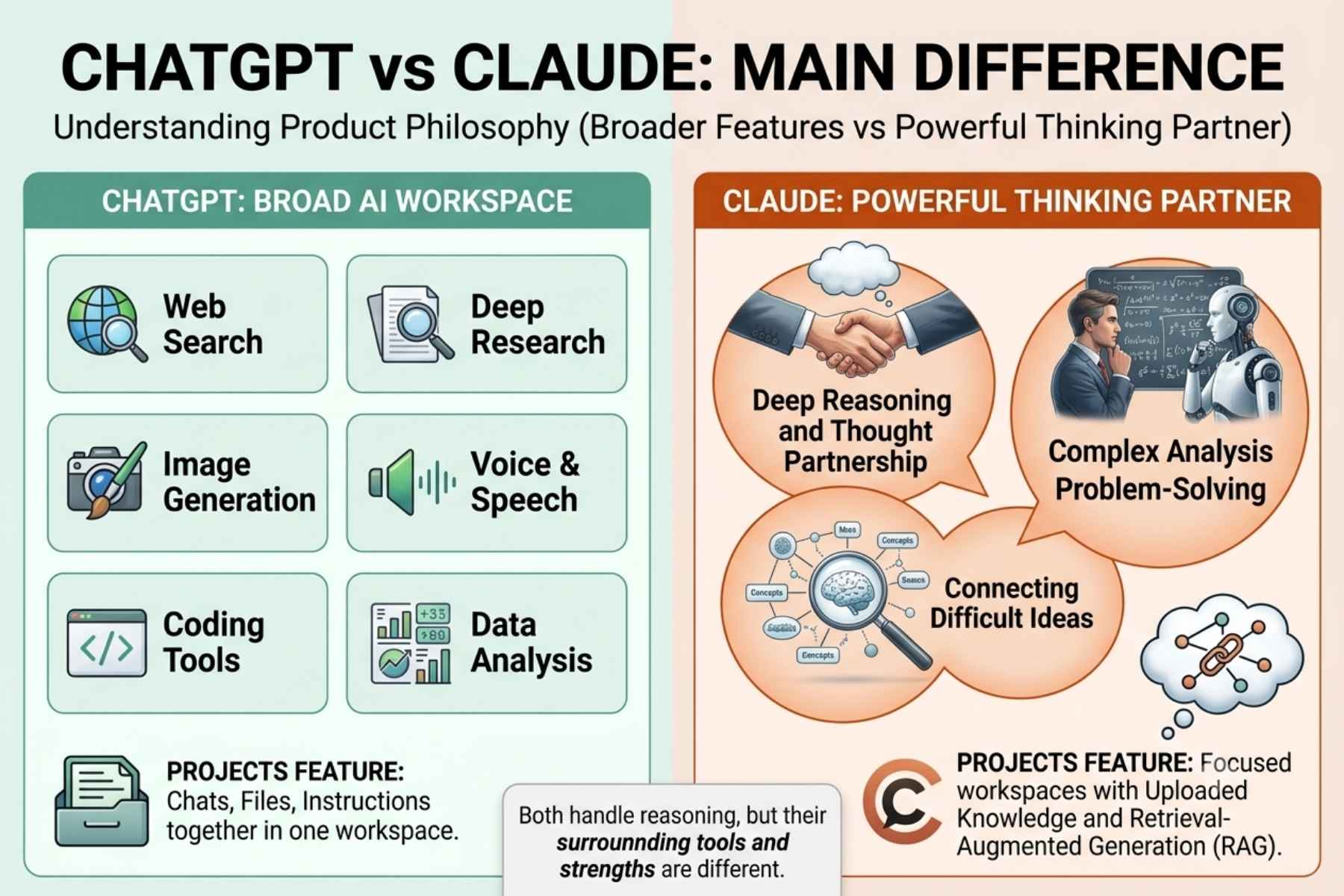
The easiest way to understand the difference is to think about their product philosophies.
ChatGPT focuses heavily on being a broad AI workspace.
Claude focuses heavily on being a powerful thinking and working partner.
That does not mean ChatGPT cannot handle serious reasoning or Claude cannot perform everyday tasks. Both can do a lot.
The difference becomes more noticeable when you look at the surrounding tools.
ChatGPT offers an extensive collection of features, including web search, deep research, image generation, voice, projects, data analysis, and coding-related tools. OpenAI’s Projects feature lets users keep chats, files, instructions, and related work together in one workspace.
Claude also provides Projects, allowing users to create focused workspaces with uploaded knowledge, instructions, and conversation history. Anthropic says its project knowledge can use retrieval-augmented generation to expand the amount of information that can be handled within a project.
The result is that both platforms can support long-running work, but their strengths and interfaces are different.
ChatGPT vs Claude for Writing
Writing is one of the most common reasons people use AI assistants.
Both ChatGPT and Claude are capable of producing articles, reports, emails, scripts, summaries, product descriptions, social media posts, outlines, and other forms of content.
However, they can feel different when producing longer pieces.
ChatGPT for Writing
ChatGPT is highly flexible.
You can ask it to write in a specific tone, change the reading level, create an outline, rewrite paragraphs, summarize research, generate multiple versions, and combine information from different sources.
Its broader tool ecosystem also matters.
For example, ChatGPT can combine web search, uploaded information, project context, and other tools when appropriate. Its Canvas workspace was designed specifically for writing and coding tasks that require editing and revision, although current model compatibility varies by model.
For bloggers, marketers, students, and general users, this makes ChatGPT a highly practical writing assistant.
Claude for Writing
Claude has developed a strong reputation for natural-sounding long-form writing.
Many users prefer Claude when they want a document that feels less formulaic and more consistent across a long response.
Claude can also work well when you provide substantial background material and ask it to maintain a particular voice throughout a project.
This becomes especially useful for:
- Long reports
- Research notes
- Business documents
- Technical documentation
- Books and manuscripts
- Content planning
- Editing large documents
- Brand style guides
Writing Winner
There is no absolute winner.
For overall writing flexibility and integrated tools, ChatGPT has an advantage.
For long-form drafting, document-focused workflows, and maintaining context, Claude can be an excellent choice.
Verdict: Tie, with different strengths.
ChatGPT vs Claude for Coding
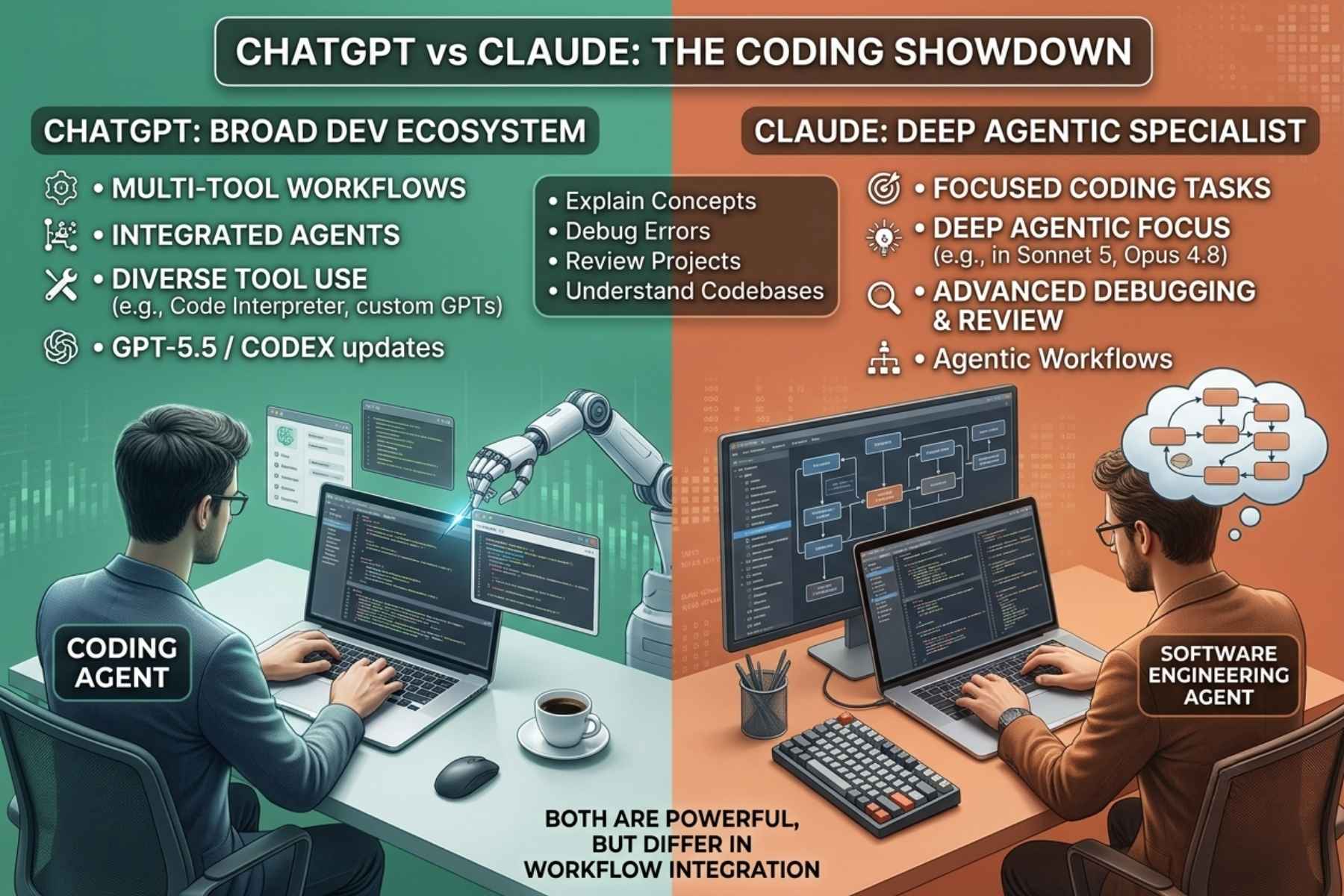
Coding is another area where the competition has become much closer.
Both platforms can generate code, explain programming concepts, debug errors, review existing projects, and help developers understand unfamiliar codebases.
ChatGPT has invested heavily in coding agents and developer workflows through Codex and its broader reasoning models. OpenAI describes GPT-5.5 as a model designed for agentic coding and knowledge work, while Codex continues to receive updates for development workflows.
Claude has also made coding a major part of its ecosystem.
Claude Code is designed to work directly with software development tasks, while Anthropic’s latest Claude models emphasize agentic coding, tool use, debugging, planning, and longer-running tasks. Claude Opus 4.8, for example, is designed to sustain complex agentic tasks and improve code review and debugging.
Claude Sonnet 5 also focuses heavily on agentic software engineering and tool use.
Which Is Better for Programming?
For simple coding questions, both are excellent.
For building a small website, either can generate useful HTML, CSS, and JavaScript.
For debugging, both can analyze error messages and suggest fixes.
For large software projects, the choice becomes more personal.
Claude can be particularly attractive to developers who want a focused coding workflow and strong long-context handling.
ChatGPT is attractive to developers who want coding combined with research, general reasoning, image generation, data analysis, and a wider set of AI tools.
Verdict: Very close. Claude has a particularly strong developer-focused workflow, while ChatGPT offers broader integration.
ChatGPT vs Claude for Research
Research is no longer limited to asking an AI what it knows.
Modern AI assistants can search information, analyze documents, compare sources, organize findings, and produce structured reports.
ChatGPT has a dedicated Deep Research capability.
OpenAI describes Deep Research as a system that plans and performs multi-step online research, analyzes information from multiple sources, and produces documented reports. It can use public websites, uploaded files, and connected applications, depending on availability.
ChatGPT also offers regular web search for quickly finding current information. OpenAI distinguishes standard search from Deep Research, with Deep Research designed for more complex multi-step investigations.
Claude is also highly capable at research, especially when the user supplies large collections of documents or needs a model to reason over substantial context.
Claude’s long-context capabilities can be valuable for research projects involving lengthy reports, transcripts, papers, technical documents, or datasets.
Research Winner
For web-based research with integrated search and documented research workflows, ChatGPT has a strong advantage.
For analyzing large collections of provided information, Claude can be extremely effective.
Winner: ChatGPT for general research, Claude for certain document-heavy research workflows.
ChatGPT vs Claude for Long Documents
This is one category where Claude deserves special attention.
Long-context AI is useful when you need to provide a model with:
- A complete book
- A long research paper
- Large technical documentation
- Multiple reports
- Large codebases
- Contracts
- Meeting transcripts
- Extensive project notes
Claude has invested heavily in long-context capabilities. Anthropic’s Claude Opus 4.6 supports a 1-million-token context window in beta, and its context-management approach is designed for longer tasks.
Claude Projects also allow users to store documents and project-specific information so future chats can work from the same knowledge base.
ChatGPT Projects provide a similar concept by keeping chats, uploaded files, and custom instructions together.
Winner for Long Documents
Claude gets the edge, especially for users whose work revolves around very large documents and long-context workflows.
ChatGPT vs Claude for Students
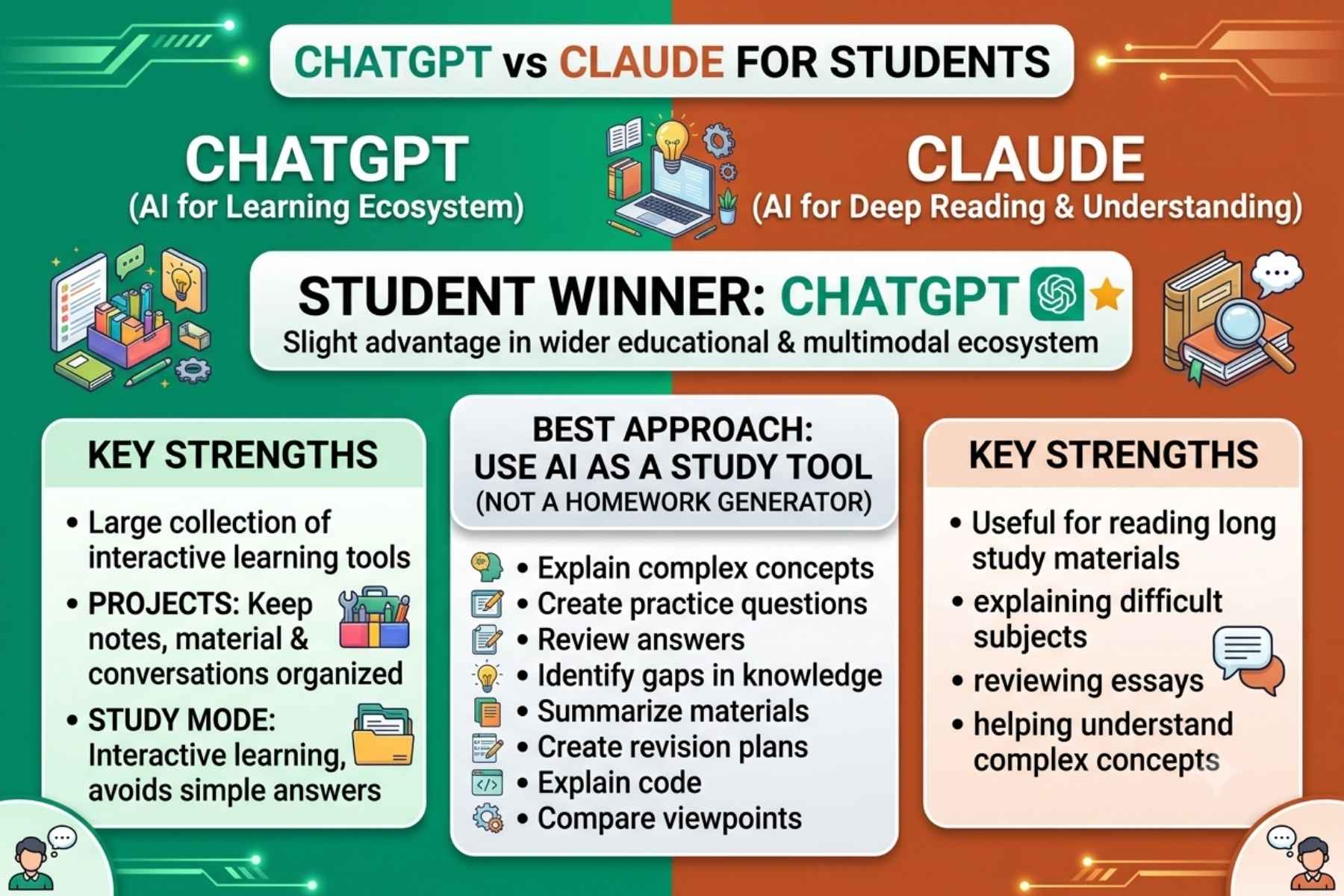
Students can use both AI assistants for learning, research, writing, brainstorming, coding, and exam preparation.
ChatGPT has an advantage because of its broad collection of learning and interactive tools.
Projects can keep course materials, notes, and conversations together. ChatGPT also provides Study Mode in supported experiences, designed to encourage interactive learning rather than simply giving an answer.
Claude can be useful for reading long study materials, explaining difficult subjects, reviewing essays, and helping students understand complex concepts.
The best approach is not to use either AI simply to generate homework and submit it unchanged.
Instead, students can use AI to:
- Explain difficult concepts.
- Create practice questions.
- Review their own answers.
- Identify gaps in understanding.
- Summarize study materials.
- Create revision plans.
- Explain programming concepts.
- Compare different viewpoints.
Student Winner
ChatGPT has a slight advantage because of its wider educational and multimodal ecosystem.
ChatGPT vs Claude for Business
Businesses have different requirements from individual users.
A business may need AI for:
- Customer communication
- Internal documents
- Research
- Data analysis
- Coding
- Marketing
- Presentations
- Reports
- Automation
- Knowledge management
ChatGPT’s broad ecosystem makes it attractive to companies that want one platform for many different tasks.
OpenAI provides business and enterprise offerings with access to advanced models and tools, while flexible usage and credit-based systems can apply to certain advanced capabilities.
Claude is also heavily focused on business and enterprise work. Anthropic has positioned Claude’s models for coding, knowledge work, document analysis, spreadsheets, presentations, and agentic workflows.
Business Winner
For businesses wanting a broad AI platform, ChatGPT is often the easier all-around choice.
For organizations with heavy document, coding, and knowledge-work requirements, Claude can be an excellent alternative.
ChatGPT vs Claude for Image Generation
This category is relatively straightforward.
ChatGPT has native image-generation capabilities integrated into its ecosystem.
That makes it useful for users who want to move between text, research, images, and other AI tasks without leaving the same platform.
Claude’s main focus is different. It is primarily a text, reasoning, coding, and knowledge-work assistant rather than a dedicated image-generation platform.
Therefore, if image creation is an important part of your workflow, ChatGPT is the stronger choice.
Winner: ChatGPT
ChatGPT vs Claude for Voice
Voice interaction has become an important AI feature because users increasingly want to speak naturally with AI instead of typing every prompt.
ChatGPT supports live voice conversations, with availability and limits depending on the plan. OpenAI’s current documentation lists voice access across Free, Go, Plus, Pro, Business, and other plans with different limits.
Claude also supports conversational interactions, but ChatGPT’s voice ecosystem is particularly mature for general consumers.
For people who want to practice languages, brainstorm ideas, ask questions while multitasking, or have a more natural conversation, ChatGPT is generally the stronger option.
Winner: ChatGPT
ChatGPT vs Claude for Projects
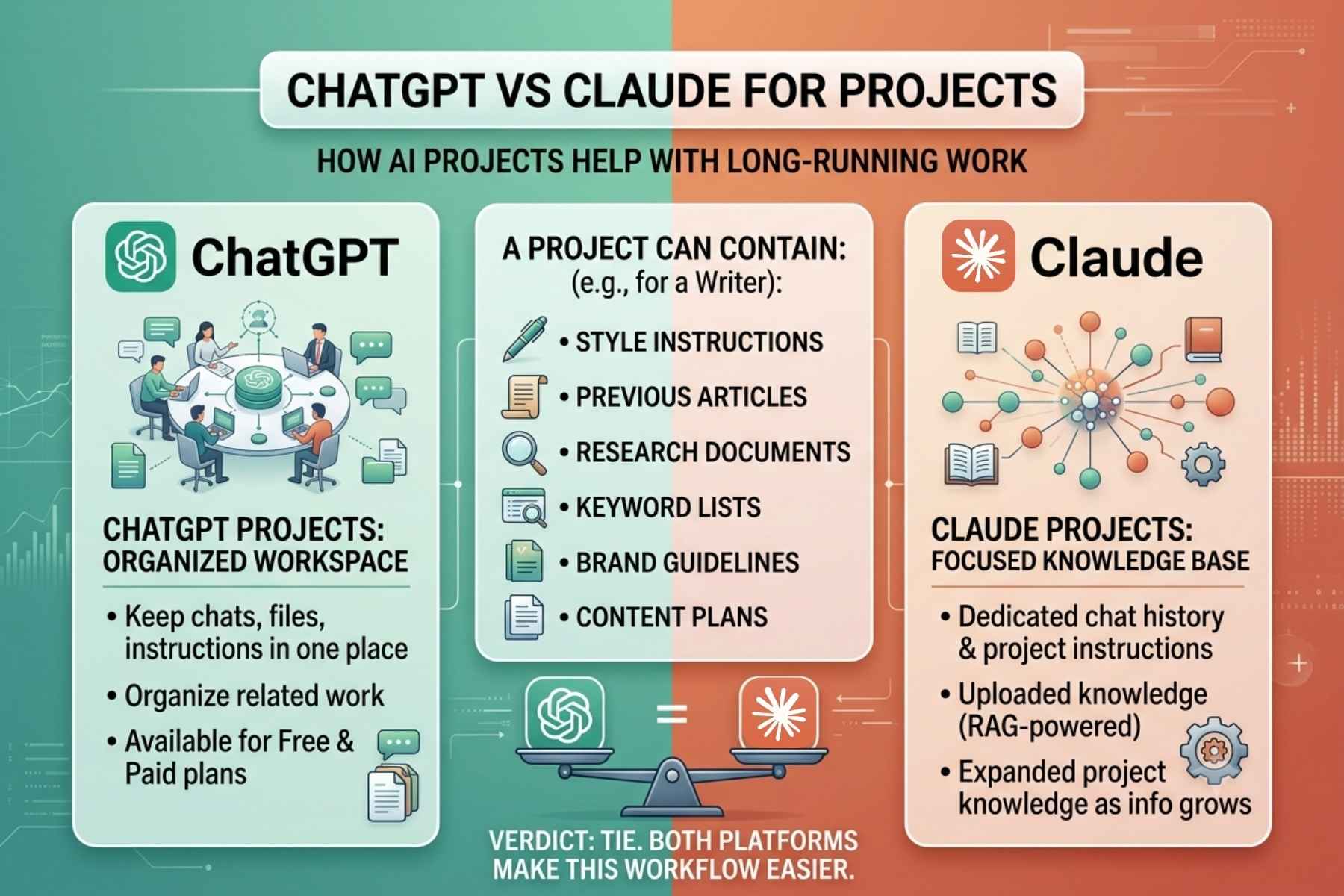
Both platforms understand that AI becomes more useful when it remembers the context of a long-running project.
ChatGPT Projects allow users to organize chats, files, instructions, and related work in one workspace. Projects are available across free and paid ChatGPT subscriptions, while some advanced tools vary according to plan.
Claude Projects provide focused workspaces with their own chat history, uploaded knowledge, and project instructions. Anthropic also uses retrieval-augmented generation to expand project knowledge as the information grows.
For a writer, for example, a project could contain:
- Style instructions
- Previous articles
- Research documents
- Keyword lists
- Brand guidelines
- Content plans
Both tools can make this workflow easier.
Verdict: Tie.
Claude Artifacts vs ChatGPT Canvas
This is one of the more interesting differences between the platforms.
Claude Artifacts are designed to turn conversations into usable outputs such as documents, code, interactive components, and applications.
Anthropic describes Artifacts as a way to create interactive apps and digital products directly from Claude conversations.
For example, you can ask Claude to create an interactive calculator, prototype, dashboard, educational tool, or small application.
ChatGPT’s Canvas is designed more around collaborative editing of writing and code. It allows users to edit content directly, request targeted changes, review versions, and work with code.
So the two tools have overlapping purposes but different personalities.
Claude Artifacts: excellent for interactive creations and prototypes.
ChatGPT Canvas: excellent for editing and refining writing or code.
ChatGPT vs Claude for SEO and Content Creation
For bloggers and website owners, both tools can be useful.
ChatGPT can help with:
- Keyword research ideas
- Search intent analysis
- Article outlines
- Meta descriptions
- Content briefs
- FAQ sections
- Content updates
- Competitor research
- Social media posts
- Image concepts
- Content calendars
Its web search and research features can also help when current information is required.
Claude can be useful for:
- Long-form articles
- Editing
- Content restructuring
- Brand voice
- Large content projects
- Reviewing lengthy source materials
- Creating detailed content briefs
However, neither ChatGPT nor Claude should be treated as a magic SEO button.
Search rankings depend on many factors, including content quality, relevance, authority, technical SEO, user experience, internal linking, competition, and the quality of information presented.
Using AI does not automatically make content rank.
The better strategy is to use AI as a research and writing assistant while adding genuine value, original analysis, accurate information, examples, and useful experience.
Content Creation Winner
ChatGPT is slightly better for an all-in-one content workflow.
Claude is particularly strong for long-form editing and document-focused writing.
ChatGPT vs Claude for Developers
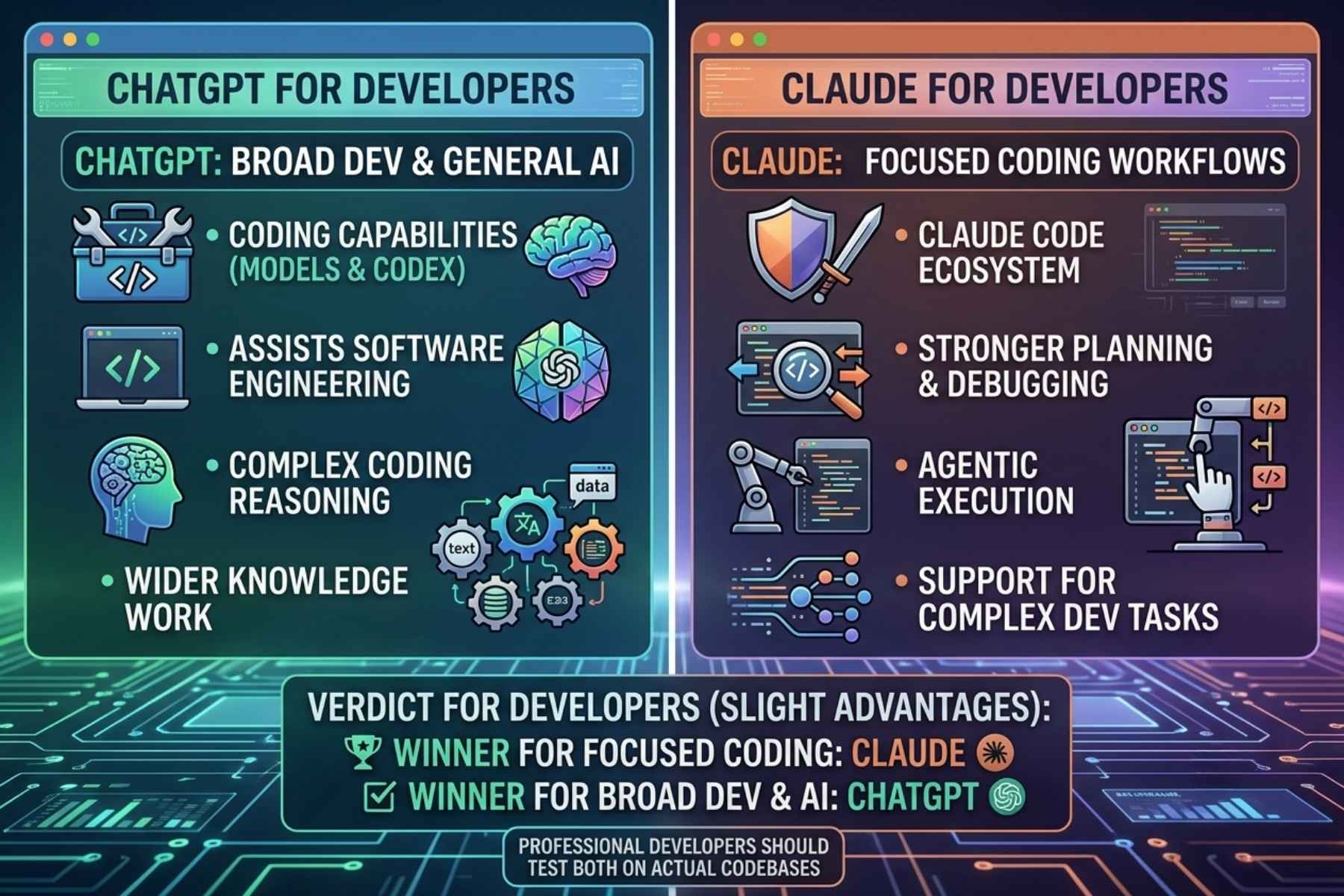
Developers have more choices than ever.
ChatGPT provides coding capabilities through its models and Codex ecosystem. Codex is designed to assist with software engineering tasks, while OpenAI’s newer reasoning models target complex coding and knowledge-work problems.
Claude has Claude Code, which has become an important part of Anthropic’s developer ecosystem.
Anthropic has continued improving Claude Code with stronger planning, agentic execution, debugging, and support for complex development tasks.
If you are a beginner learning programming, either platform can help.
If you are a professional developer working on a large repository, it is worth testing both with your actual codebase because performance can vary significantly by language, architecture, tooling, and task type.
Developer Winner
Claude has a slight edge for focused coding workflows.
ChatGPT has a strong edge for broader development plus general AI tasks.
ChatGPT vs Claude: Pros and Cons
ChatGPT Pros
- Broad range of AI capabilities
- Strong general-purpose assistant
- Web search
- Deep research
- Image generation
- Voice interaction
- Projects
- Strong coding capabilities
- Data analysis
- Large ecosystem
- Useful for students, writers, developers, and businesses
ChatGPT Cons
- Feature availability can vary by plan
- Usage limits may apply
- The large number of features can feel overwhelming
- Model availability changes over time
- Some advanced capabilities require paid access
Claude Pros
- Excellent long-form writing
- Strong reasoning
- Excellent long-context capabilities
- Strong coding performance
- Claude Code
- Projects
- Artifacts
- Good document analysis
- Strong agentic workflows
- Useful for large technical and professional projects
Claude Cons
- Some capabilities are less broad than ChatGPT’s ecosystem
- Image-generation capabilities are not its primary focus
- Usage limits vary by plan
- Advanced features can require paid access
- Users who want an all-in-one multimodal platform may prefer ChatGPT
Which Is Better for Beginners?
If you are completely new to AI tools, ChatGPT is probably the easier starting point.
The reason is simple.
You can use it for almost anything.
You can ask questions, write content, generate images, search the web, analyze files, practice a language, study, brainstorm ideas, and work on coding.
Claude is also beginner-friendly, but its strengths become especially obvious when you start working with longer documents, serious writing projects, programming tasks, and structured workflows.
Beginner winner: ChatGPT
Which Is Better for Writers?
This is much closer.
If your priority is long-form writing, editing, maintaining a consistent voice, and working with large amounts of source material, Claude deserves serious consideration.
If you want writing combined with research, image generation, web search, projects, voice, and other tools, ChatGPT may be more convenient.
Writer winner: Claude for focused writing, ChatGPT for broader content workflows.
Which Is Better for Programmers?
For programmers, both are excellent.
Claude has developed a strong reputation around coding and agentic development, especially through Claude Code.
ChatGPT offers Codex and powerful reasoning models, along with the benefit of a broader AI ecosystem.
For simple coding, there may be very little practical difference.
For large projects, the best choice depends on your development environment and workflow.
Programmer winner: Claude by a narrow margin for focused coding.
Which Is Better for Researchers?
For web-based research, ChatGPT has a significant advantage because of its dedicated Deep Research workflow and web-search ecosystem.
For analyzing large uploaded documents and maintaining extensive project context, Claude can be highly competitive.
Research winner: ChatGPT overall.
Which Is Better for Business?
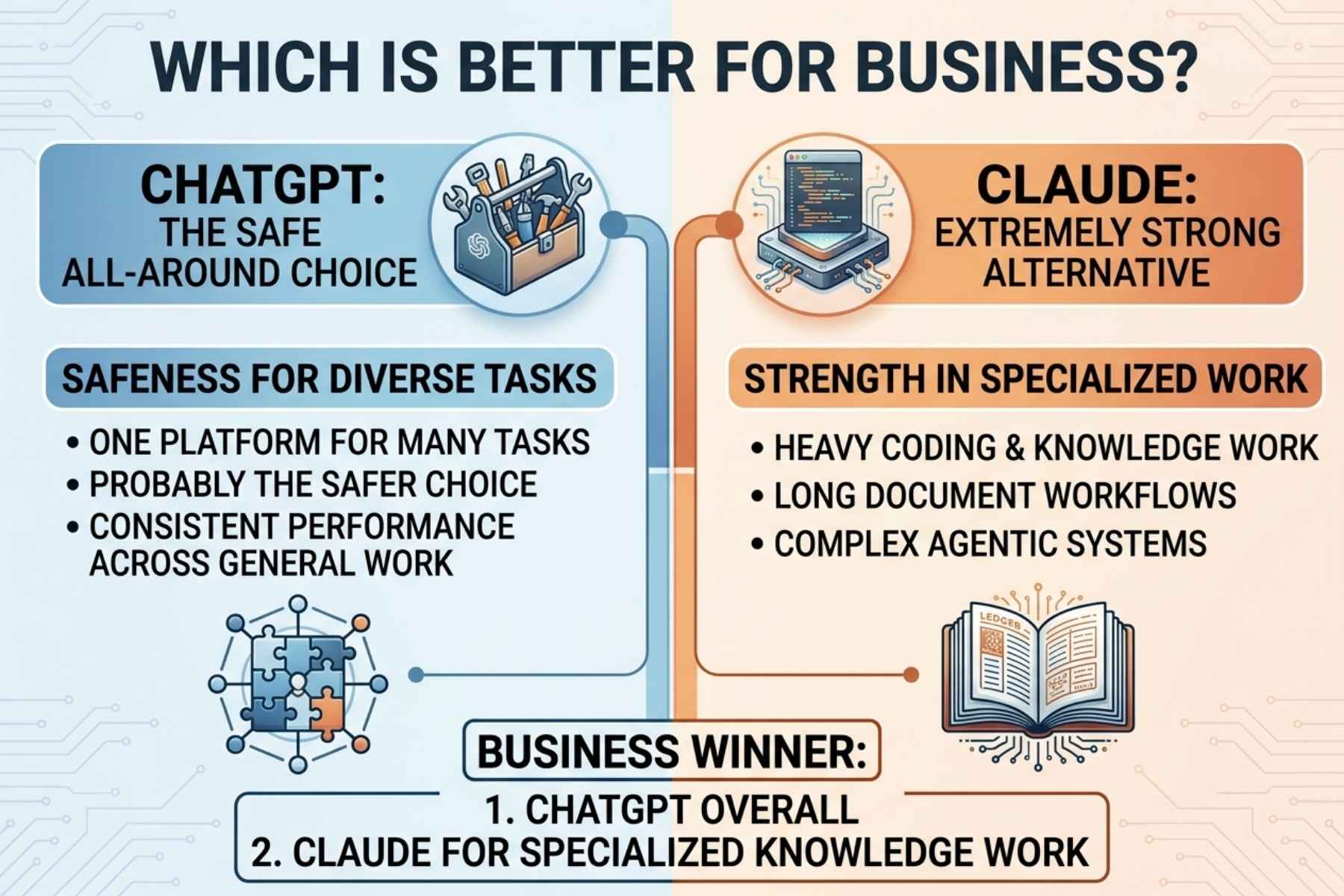
For a business that wants one AI platform for many different tasks, ChatGPT is probably the safer all-around choice.
For companies with heavy coding, knowledge management, long-document, and agentic workflows, Claude is an extremely strong alternative.
Business winner: ChatGPT overall, Claude for specialized knowledge work.
Which AI Is Better in 2026?
After comparing the major categories, the answer depends on what you actually need.
If we judge the platforms as complete AI ecosystems, ChatGPT is the better overall choice for most users in 2026.
Its biggest advantage is versatility.
You can use one platform for writing, research, coding, image generation, voice conversations, web search, projects, document analysis, and other tasks.
Claude’s biggest advantage is depth in certain workflows.
If your daily work involves long documents, large contexts, software development, complex writing, technical analysis, or agentic workflows, Claude can be an excellent choice and may outperform ChatGPT for your specific needs.
This is why asking “Which AI is smarter?” is not always useful.
A better question is:
Which AI fits my workflow better?
ChatGPT vs Claude: Final Verdict
There is no single AI assistant that wins every category.
ChatGPT is the better all-purpose AI platform.
Claude is one of the strongest choices for long-form writing, large-context work, coding, and focused professional workflows.
Here is the final breakdown:
| Use Case | Better Choice |
| General AI assistant | ChatGPT |
| Web research | ChatGPT |
| Deep research | ChatGPT |
| Image generation | ChatGPT |
| Voice | ChatGPT |
| Long documents | Claude |
| Long-form writing | Claude |
| Coding | Claude / Tie |
| Large codebases | Claude |
| Projects | Tie |
| Interactive artifacts | Claude |
| Data and general productivity | ChatGPT |
| Students | ChatGPT |
| Business | ChatGPT |
| All-in-one AI platform | ChatGPT |
For most people, I would start with ChatGPT because it provides the broadest range of capabilities in one place.
However, if you are a developer, professional writer, researcher, or someone who regularly works with extremely large documents, Claude is absolutely worth trying.
In fact, the smartest approach may not be choosing only one.
Many advanced users can benefit from using ChatGPT and Claude together.
You can use ChatGPT for research, brainstorming, web-based information gathering, images, general productivity, and multimodal tasks. You can then use Claude for long-form editing, document analysis, coding, or another stage of the same workflow.
The goal should not be to find the AI that wins every benchmark.
The goal is to find the AI that helps you complete your work more accurately, efficiently, and consistently.
Frequently Asked Questions
Is ChatGPT better than Claude in 2026?
ChatGPT is better overall for users who want a broad AI platform with features such as web search, deep research, image generation, voice, projects, coding, and general productivity. Claude can be better for long-context work, focused writing, coding, and certain professional workflows.
Is Claude better than ChatGPT for writing?
Claude can be an excellent choice for long-form writing and editing, especially when a project contains substantial context or source material. ChatGPT is also highly capable and offers a wider set of tools around the writing process.
Is ChatGPT better than Claude for coding?
Both are excellent coding assistants. Claude has a particularly strong developer ecosystem through Claude Code, while ChatGPT offers Codex and powerful reasoning models. The best option depends on the programming language, project size, tools, and workflow.
Which is better for students, ChatGPT or Claude?
ChatGPT is generally the better choice for students because it combines learning support with web search, projects, voice, image capabilities, document analysis, and other tools. Claude is also useful for studying, particularly when students need to analyze long documents or receive detailed explanations.
Can I use ChatGPT and Claude together?
Yes. Using both can be useful because their strengths overlap but are not identical. For example, you could use ChatGPT for research and brainstorming and Claude for editing a long document or reviewing a large codebase.
Which is cheaper, ChatGPT or Claude?
The answer depends on the exact consumer subscription, plan, region, usage limits, and whether you are comparing chatbot subscriptions or API pricing. Both companies offer free access and paid tiers, while API pricing varies by model. Check the current official pricing before subscribing.
Is Claude safer than ChatGPT?
It is not accurate to declare one universally safer for every situation. Both companies invest heavily in model safety and responsible AI development. Users should still review important outputs, avoid sharing unnecessary sensitive information, and verify important factual claims.
Which AI is best for SEO content?
Both can help with SEO content. ChatGPT is especially useful when SEO work requires web research, content planning, keyword ideas, structured outlines, and multimodal workflows. Claude can be particularly useful for long-form drafting, editing, and maintaining a consistent writing style.
Should I pay for ChatGPT or Claude?
Choose ChatGPT if you want a broad AI toolkit and use features such as research, web search, image generation, voice, coding, and projects.
Choose Claude if your main priorities are long-form writing, large documents, coding, and focused professional workflows.
If you are unsure, try the free versions of both first and compare them using your actual tasks.
Conclusion
The ChatGPT vs Claude debate is no longer simply about which chatbot gives better answers.
Both platforms have evolved into sophisticated AI workspaces capable of handling much more than basic conversations.
ChatGPT stands out because of its broad ecosystem. It combines conversational AI with search, deep research, image generation, voice, projects, coding, document analysis, and other productivity features. For users who want one AI assistant capable of handling many different tasks, it is difficult to beat.
Claude takes a different but equally impressive approach. Its strengths in long-context reasoning, writing, coding, document analysis, Projects, Artifacts, and agentic workflows make it a powerful choice for professionals and developers.
So, which one is best?
For most general users, ChatGPT is the better overall AI assistant in 2026.
For developers, writers, researchers, and professionals working heavily with large documents or complex coding tasks, Claude may be the better fit.
Ultimately, there is no reason to treat the choice as permanent. AI models are improving rapidly, features change frequently, and a tool that is best for one workflow may not be best for another.
The most practical solution is to test both with real work.
Give each AI the same difficult task. Compare the accuracy, writing quality, reasoning, speed, context handling, coding ability, and amount of editing you need to do afterward.
That real-world comparison will tell you much more than a simple leaderboard.
And in 2026, that is perhaps the most important lesson from the ChatGPT vs Claude competition: the best AI is not necessarily the one with the biggest list of features. It is the one that consistently helps you get better work done.
Explore More: Meta AI Tool 2026: Complete Guide to Features, Uses & How to Make Money