The global artificial intelligence industry is entering a decisive phase in 2026, as competition in AI hardware intensifies like never before. At the center of this transformation stands a rapidly growing challenge to Nvidia’s long-held dominance, the emergence of a powerful China AI Chip developed by Chinese technology firms and research institutions. Once considered years behind the United States in advanced semiconductor design, China has now begun to close the gap, triggering serious concern among global chipmakers and investors.
For more than a decade, Nvidia has been the undisputed leader in AI accelerators, providing GPUs that power everything from generative AI models to autonomous vehicles and data centers. However, recent developments suggest that the rise of the China AI Chip could disrupt the balance of power in the global AI ecosystem. With performance improvements, cost efficiency, and strong government backing, China’s AI hardware ambitions are no longer theoretical; they are real, measurable, and accelerating fast.
This article explores how China’s new AI chip threatens Nvidia’s market leadership, why this development matters globally, and what it means for the future of AI innovation in 2026 and beyond.
The Importance of AI Chips in the Modern Tech World

Artificial intelligence systems depend heavily on specialized hardware. Traditional CPUs cannot efficiently handle the massive parallel computations required for training and deploying AI models. This gap gave rise to AI-specific chips such as GPUs, TPUs, and neural processing units.
Nvidia built its empire by recognizing this shift early. Its GPUs became the backbone of AI research, cloud platforms, and enterprise solutions worldwide. Today, nearly every major AI breakthrough from large language models to real-time image processing relies on Nvidia hardware.
However, AI chips are not just a technological asset; they are also a geopolitical one. Control over advanced AI hardware translates into economic power, national security advantages, and technological independence. This is precisely why the China AI Chip initiative has gained momentum.
Why China Is Investing Heavily in AI Chip Development
China’s push toward AI chip independence did not emerge overnight. Several factors have accelerated this mission:
1. U.S. Export Restrictions
Over the past few years, the United States has imposed strict export controls on advanced semiconductors and AI chips, limiting China’s access to Nvidia’s most powerful GPUs. These restrictions forced Chinese firms to accelerate domestic innovation rather than rely on foreign suppliers.
2. National AI Strategy
China’s government has identified artificial intelligence as a strategic priority. Massive funding, policy support, and public-private collaboration have enabled rapid progress in chip design and manufacturing.
3. Growing Domestic Demand
China has one of the largest AI markets in the world. From smart cities and facial recognition to autonomous driving and industrial automation, the need for high-performance AI chips is enormous. A locally produced China AI Chip reduces costs and ensures long-term supply stability.
What Makes the New China AI Chip Different?
Unlike early attempts that struggled with performance and efficiency, the latest China AI Chip reportedly offers competitive capabilities in several key areas:
- Improved performance per watt, making it suitable for data centers
- Advanced parallel processing optimized for AI workloads
- Scalable architecture for training large AI models
- Lower production costs compared to Nvidia GPUs
While Nvidia still leads in software ecosystem maturity, China’s chipmakers are rapidly improving compatibility with popular AI frameworks. This progress makes the new AI chip increasingly attractive for domestic and regional markets.
Nvidia’s Dominance Under Pressure
Nvidia’s success has been built on three pillars: cutting-edge hardware, a powerful software ecosystem (CUDA), and global trust. However, the rise of the China AI Chip challenges all three.
First, Chinese cloud providers and enterprises are beginning to test and deploy domestic chips at scale. Second, local AI frameworks are being optimized specifically for Chinese hardware. Third, geopolitical uncertainty makes long-term reliance on foreign chips risky for Chinese companies.
As adoption grows, Nvidia may face declining sales in one of the world’s largest AI markets, a development that could reshape its revenue trajectory in 2026.
Global Implications of the China AI Chip vs Nvidia Rivalry

This competition is not limited to China and the United States. The global AI supply chain is watching closely. If the China AI Chip proves successful, other countries may follow a similar path toward semiconductor independence.
For developing economies, affordable AI chips could accelerate digital transformation. For established tech powers, increased competition could drive faster innovation and lower prices.
At the same time, the AI chip race raises concerns about fragmentation. Different hardware standards and software ecosystems could complicate global collaboration and interoperability.
What Comes Next?
The emergence of the China AI Chip marks a turning point in the AI hardware industry. While Nvidia remains the global leader, its dominance is no longer unchallenged. The year 2026 could become a defining moment where AI chip leadership shifts from a single-player market to a truly competitive global landscape.
In the next part, we will explore technical comparisons between China AI Chip and Nvidia GPUs, including performance, architecture, and real-world use cases.
Understanding the Architecture Behind the China AI Chip
The success of any AI processor depends heavily on its internal architecture. Nvidia GPUs are widely known for their massively parallel design, allowing thousands of cores to process AI workloads simultaneously. However, the latest China AI Chip introduces a different architectural approach, focusing on AI-specific efficiency rather than general-purpose graphics processing.
Chinese chip designers have optimized their architecture for neural networks, matrix multiplication, and tensor operations. Instead of relying on traditional GPU logic, the China AI Chip integrates dedicated AI cores designed exclusively for deep learning tasks. This allows better performance consistency in AI inference and training environments.
Another important architectural feature is modular scalability. Chinese manufacturers are reportedly designing chips that can be stacked or interconnected efficiently, enabling data centers to scale AI workloads without relying on Nvidia’s proprietary interconnect technologies.
Performance Comparison: China AI Chip vs Nvidia GPUs

Performance is where Nvidia has historically dominated. However, recent benchmarks suggest that the performance gap is narrowing faster than expected.
AI Training Performance
Nvidia GPUs still lead in large-scale AI training, especially for advanced generative AI models. Their mature software ecosystem and optimized libraries offer unmatched stability. However, the China AI Chip shows competitive performance in mid-scale training tasks, particularly in natural language processing and computer vision.
For Chinese companies focused on domestic AI solutions, the slight performance trade-off is acceptable given lower costs and reduced dependency on foreign suppliers.
AI Inference Efficiency
Inference is where the China AI Chip shines. AI inference requires fast, energy-efficient processing rather than raw power. Chinese chips demonstrate strong inference performance with significantly lower power consumption, making them ideal for edge computing, smart surveillance, and industrial automation.
In many real-world scenarios, inference efficiency matters more than peak performance giving China’s chip a strategic advantage.
Power Consumption and Cost Efficiency
One of the biggest concerns with Nvidia GPUs is their high energy demand. Large AI data centers require massive cooling and electricity infrastructure. The China AI Chip is reportedly optimized for lower power consumption, which translates into reduced operational costs.
From a business perspective, this makes a major difference. Cloud providers and enterprises can deploy AI solutions at scale without incurring extreme energy expenses. Lower cost per AI workload could accelerate adoption across emerging markets.
Software Ecosystem: Nvidia’s Strength vs China’s Rapid Progress
Nvidia’s CUDA platform remains its strongest asset. Developers worldwide rely on CUDA-optimized frameworks such as TensorFlow and PyTorch. This mature ecosystem gives Nvidia a significant edge.
However, Chinese developers are rapidly building alternative software stacks designed specifically for the China AI Chip. Open-source frameworks, domestic AI libraries, and localized development tools are being optimized for compatibility and performance.
While Nvidia’s ecosystem is still superior globally, China’s software environment is improving fast especially for companies operating exclusively within the Chinese market.
Real-World Applications of the China AI Chip
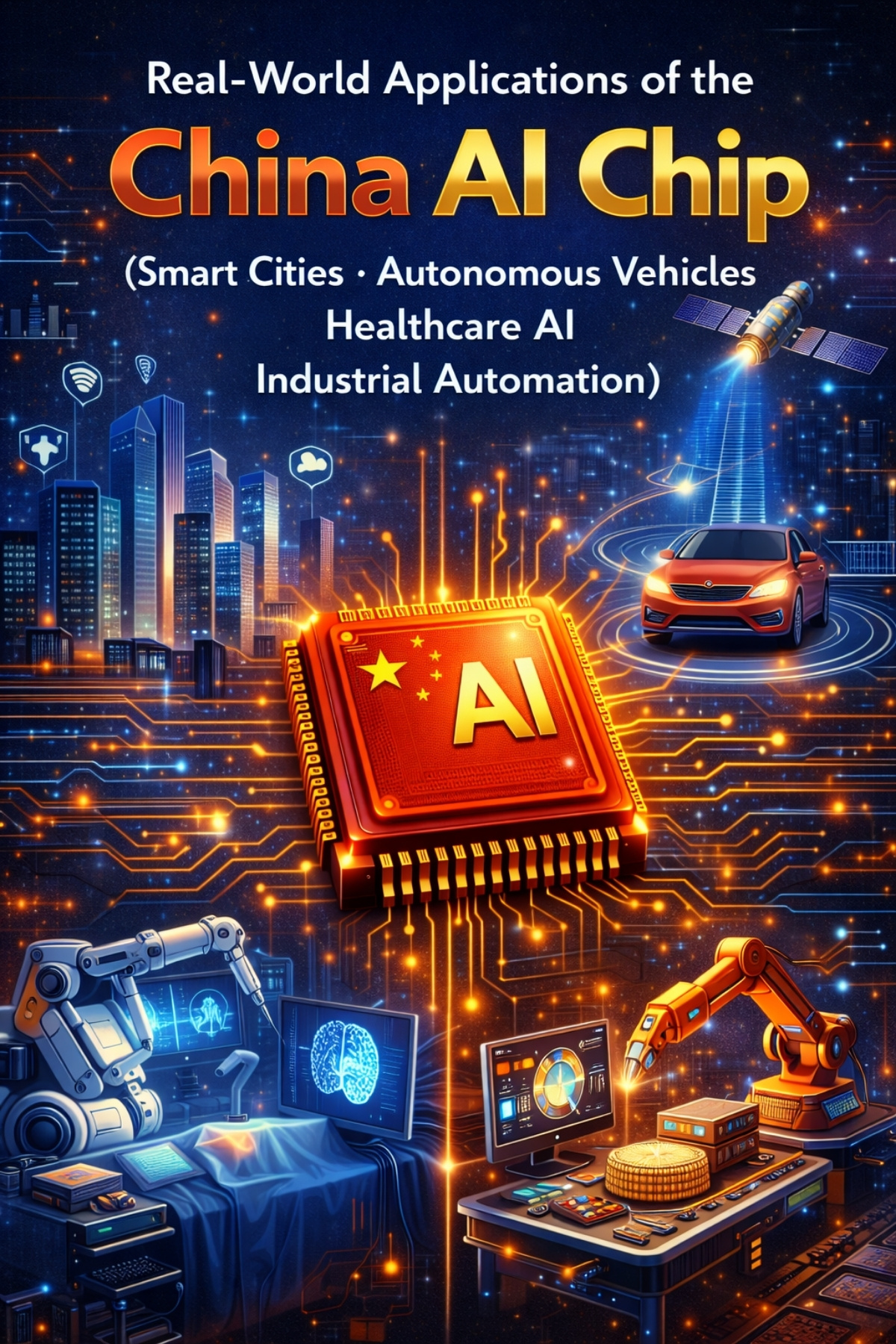
The real test of any AI processor lies in practical applications. The China AI Chip is already being tested or deployed in several key sectors:
1. Smart Cities
AI-powered traffic management, facial recognition, and public safety systems rely heavily on inference efficiency. China’s AI chip is well-suited for these large-scale, real-time applications.
2. Autonomous Vehicles
Chinese EV manufacturers are exploring domestic AI chips to reduce costs and ensure supply chain security. AI chips optimized for perception and decision-making offer strong potential in this space.
3. Healthcare AI
Medical imaging, diagnostics, and patient monitoring require reliable AI inference. Lower power consumption and stable performance make the China AI Chip attractive for hospital environments.
4. Industrial Automation
Factories and manufacturing plants increasingly rely on AI-driven automation. Domestic AI chips reduce dependency on foreign hardware and support long-term scalability.
Why Nvidia Should Be Concerned
The rise of the China AI Chip does not mean Nvidia will disappear. However, it signals a shift toward regional competition. Losing dominance in China, one of the world’s largest AI markets could significantly impact Nvidia’s future growth.
Additionally, success in China could inspire other countries to invest in domestic AI chip development, further fragmenting Nvidia’s global market share.
Market Response and Industry Reactions
Global investors and tech analysts are closely watching this rivalry. While Nvidia continues to dominate stock markets, Chinese chipmakers are gaining attention as serious long-term competitors.
Some industry experts believe the future of AI hardware will be multi-polar rather than centralized. In this scenario, Nvidia remains a leader but not the only one.
Geopolitical Impact of the China AI Chip vs Nvidia Rivalry
The rise of the China AI Chip is not just a technological event it is a geopolitical milestone. Artificial intelligence has become a core element of national power, influencing defense systems, economic growth, and global influence. As a result, AI chips are now treated as strategic assets rather than simple commercial products.
U.S. restrictions on advanced semiconductor exports were intended to slow China’s AI progress. Instead, they accelerated domestic innovation. The development of a competitive China AI Chip reflects how technological pressure can drive self-reliance at scale.
For Nvidia, this means operating in an increasingly politicized environment. Market access is no longer determined solely by product quality but also by international policy and trade regulations.
How the Global AI Market Is Reacting
The global AI hardware market is responding quickly to this shift. Governments, cloud providers, and enterprises are re-evaluating their dependency on a single supplier.
Diversification of AI Supply Chains
Many countries now see value in diversifying AI chip sources. If the China AI Chip proves stable and scalable, it could become an alternative option for regions seeking lower-cost AI infrastructure.
Increased Competition and Innovation
Competition between Nvidia and Chinese chipmakers is pushing innovation forward. Faster development cycles, improved energy efficiency, and specialized AI hardware are becoming the new industry standard.
Pricing Pressure
One indirect impact of the China AI Chip is pricing pressure. Nvidia may be forced to rethink pricing strategies, especially in emerging markets, where affordability plays a critical role.
Impact on Nvidia’s Long-Term Strategy
Nvidia remains a global leader, but the emergence of strong competitors forces strategic adaptation.
Focus on Premium AI Solutions
Nvidia is likely to concentrate on high-end AI training, enterprise solutions, and next-generation AI models where its ecosystem advantage remains strongest.
Expansion Beyond Hardware
Software, AI services, and integrated platforms will play a bigger role in Nvidia’s future. Competing purely on hardware becomes harder when domestic alternatives exist.
Reduced Dependence on a Single Market
China has been a major growth engine for Nvidia. The success of the China AI Chip may push Nvidia to accelerate expansion in other regions such as Southeast Asia, the Middle East, and Africa.
Risks and Challenges Facing the China AI Chip

Despite its rapid progress, the China AI Chip still faces several challenges:
- Manufacturing limitations due to restricted access to advanced fabrication technology
- Software ecosystem maturity, which still lags behind Nvidia’s CUDA platform
- Global trust issues, as some international buyers remain cautious
However, these challenges are not insurmountable. Continuous investment and domestic market scale provide China with long-term momentum.
What This Means for Developers and Businesses
For AI developers, the growing presence of the China AI Chip introduces both opportunities and complexity.
- Developers may need to optimize models for multiple hardware platforms
- Businesses gain leverage through increased supplier choice
- AI deployment costs may decrease due to competitive pricing
In the long run, a more competitive AI chip market benefits innovation and accessibility.
Future Outlook: 2026 to 2030
Looking ahead, the AI chip industry is expected to undergo major transformation.
Short-Term (2026–2027)
- Increased domestic adoption of the China AI Chip
- Nvidia maintains global leadership but faces regional decline
- Governments increase AI hardware investments
Mid-Term (2028–2029)
- Improved China AI Chip manufacturing efficiency
- Broader international interest in alternative AI chips
- Multi-vendor AI infrastructure becomes common
Long-Term (2030 and Beyond)
- AI chip leadership becomes multi-polar
- Nvidia remains dominant in premium AI markets
- China establishes itself as a major AI hardware power
The era of a single AI chip leader may be coming to an end.
Frequently Asked Questions
1. What is the China AI Chip?
The China AI Chip is a domestically developed artificial intelligence processor designed to handle AI training and inference tasks. It aims to reduce China’s dependence on foreign AI hardware and compete directly with global leaders like Nvidia.
2. Why is the China AI Chip considered a threat to Nvidia?
The China AI Chip poses a threat to Nvidia because it offers competitive performance, lower costs, and strong government support. Its adoption in China could reduce Nvidia’s market share in one of the world’s largest AI markets.
3. How does the China AI Chip compare to Nvidia GPUs?
Nvidia GPUs still lead in large-scale AI training and software ecosystem maturity. However, the China AI Chip performs well in AI inference, energy efficiency, and cost-effectiveness, making it suitable for domestic and regional applications.
4. Will the China AI Chip replace Nvidia completely?
No, the China AI Chip is unlikely to replace Nvidia globally. Nvidia remains dominant in premium AI workloads, but China’s chip is expected to coexist as a strong regional alternative, especially within China and nearby markets.
5. Why is China developing its own AI chips?
China is developing AI chips due to U.S. export restrictions, growing domestic AI demand, and the need for technological independence. The China AI Chip supports long-term economic and national security goals.
6. Is the China AI Chip used outside China?
Currently, the China AI Chip is mainly deployed within China. However, as performance improves and costs remain competitive, it may attract interest from other emerging markets in the future.
7. What industries will benefit most from the China AI Chip?
Industries such as smart cities, autonomous vehicles, healthcare AI, industrial automation, and surveillance systems are expected to benefit the most from the China AI Chip due to its efficiency and scalability.
8. How will this competition affect the global AI chip market?
Competition between Nvidia and the China AI Chip will drive innovation, reduce prices, and diversify AI hardware options globally. This could accelerate AI adoption across industries worldwide.
9. What is the future of Nvidia amid rising competition?
Nvidia is expected to remain a global AI leader by focusing on high-end AI training, advanced software platforms, and enterprise solutions, even as regional competitors like the China AI Chip gain strength.
10. Is the China AI Chip important for the future of AI in 2026?
Yes, the China AI Chip is highly significant in 2026 as it represents a shift toward a more competitive and decentralized AI hardware ecosystem.
Conclusion
The competition between Nvidia and the China AI Chip represents a defining chapter in the evolution of artificial intelligence. What began as a response to trade restrictions has evolved into a serious technological challenge with global consequences.
Nvidia is still the benchmark for AI performance and ecosystem maturity. However, China’s progress proves that dominance in AI hardware is no longer guaranteed. As innovation accelerates and markets diversify, the global AI landscape in 2026 is more competitive, complex, and dynamic than ever before.
The rise of the China AI Chip does not signal the fall of Nvidia but it does mark the beginning of a new era where leadership is contested, innovation is faster, and the future of AI is truly global.
Explore More: Google Gemini AI Tools: Complete Guide to Features, Use Cases & Benefits (2025)