A major leak in early 2026 surprised the tech community all over the world. Screenshots and internal references pointed toward something entirely new Google Aluminium OS. Unlike minor Android UI refreshes or Pixel-exclusive features, this leak hinted at a full operating system interface redesign, potentially signaling Google’s next big platform shift.
For years, Google has refined Android incrementally. Material Design, Material You, and AI-driven user interface customized have improved usability, but many experts believe Android’s foundational design has reached a plateau. The leaked Google’s Aluminium OS interface suggests Google may be preparing to go beyond Android as we know it creates a more unified, intelligent, and visually refined operating system.
This article offers a deep, professional, SEO-optimized analysis of the Google’s Aluminium OS interface leak. We’ll explore the design philosophy, leaked features, UI changes, AI integration, performance expectations, ecosystem impact, and what this could mean for users and developers worldwide.
The Significance of the Google Aluminium OS Leak at Present
Operating systems define how billions of people interact with technology every day. When Apple introduced iOS’s flat design or Microsoft launched Windows 11, it reshaped user expectations globally.
The Google’s Aluminium OS interface leak matters because:
- It hints at a post-Android future
- It aligns tightly with AI-first computing
- It suggests deeper cross-device unification
- It may redefine how Google competes with Apple, Microsoft, and emerging AI platforms
This isn’t just another UI refresh, it could be Google’s most ambitious OS move in over a decade.
Google Aluminum OS, according to leaks and analysis
According to leaked internal UI references and early design assets, Google’s Aluminium OS appears to be a lightweight, modular, AI-centric operating system designed to work seamlessly across:
- Smartphones
- Tablets
- Laptops
- Foldables
- Smart displays
- Possibly AR/XR devices
Unlike traditional Android skins, Google Aluminium OS seems to focus on performance efficiency, adaptive UI behavior, and deep Gemini AI integration.
Key Concept Behind the Name “Aluminium”
The name “Aluminium” suggests:
- Lightweight architecture
- Durability and efficiency
- Premium, minimal design
- Thermal and performance optimization metaphors
Much like aluminum hardware in modern devices, the OS appears engineered to be thin, fast, and resilient.
Google Aluminium OS Interface Leak: First Visual Impressions
The leaked interface screenshots reveal a dramatically cleaner and more fluid UI compared to Android 14/15.
Major Visual Changes Observed
1. Refined Minimalism
Google’s Aluminium OS removes visual clutter:
- Fewer sharp edges
- Softer geometry
- Consistent spacing
- Reduced UI noise
This makes the interface feel more calm, premium, and focused.
2. Layered Transparency
Similar to modern desktop OS trends:
- Frosted glass panels
- Depth-based shadows
- Context-aware blur effects
These layers adapt dynamically depending on background content and lighting conditions.
3. Unified Color Intelligence
Instead of Material You’s heavy color dominance, Google Aluminium OS uses:
- Muted base tones
- Accent highlights
- AI-selected contrast optimization
This ensures readability while preserving personalization.
Navigation System: A Radical Shift from Traditional Android
One of the most talked-about aspects of the Google’s Aluminium OS interface leak is its navigation redesign.
Adaptive Navigation Bar
The navigation system appears to be:
- Context-aware
- App-responsive
- Gesture-driven with AI prediction
For example:
- Productivity apps trigger expanded controls
- Media apps prioritize playback gestures
- Reading apps minimize UI elements automatically
This adaptive behavior reduces friction and improves usability.
Home Screen Redefined in Google Aluminium OS
The home screen in Google Aluminium OS is no longer just an app launcher, it’s an intelligent command center.
Smart Panels Instead of Static Widgets
Leaked visuals show dynamic panels that:
- Update in real time
- Combine multiple data sources
- Change layout based on user behavior
Examples include:
- AI-powered daily briefings
- Contextual reminders
- Live device status panels
Deep AI Integration: Aluminium OS as an AI-Native Platform

Unlike Android’s add-on AI features, Google Aluminium OS appears to be AI-native at the system level.
Gemini AI at the Core
The OS reportedly integrates Gemini AI for:
- Predictive UI adjustments
- Smart app prioritization
- Real-time language translation
- Personalized system suggestions
This allows the OS to anticipate user needs instead of reacting.
Performance & Efficiency: Why Aluminium OS Could Be Faster
Performance optimization seems central to the Google Aluminium OS philosophy.
Expected Improvements
- Faster app launch times
- Lower RAM consumption
- Better thermal efficiency
- Improved battery longevity
By reducing background process overhead, Google Aluminium OS may outperform traditional Android builds even on mid-range hardware.
Security & Privacy Enhancements (Leaked Indicators)
Security is another area where Google Aluminium OS appears to innovate.
System-Level Privacy Controls
Leaks suggest:
- Granular permission timelines
- AI-monitored anomaly detection
- On-device processing priority
This reduces cloud dependency and enhances trust.
Developer Perspective: A New App Ecosystem?
For developers, Google Aluminium OS could introduce:
- Modular UI frameworks
- Unified APIs across devices
- AI-assisted app optimization
This could simplify development while improving performance consistency.
How Google Aluminium OS Compares to Android 15
| Feature | Android 15 | Google Aluminium OS |
| Design | Material You | Minimal, layered |
| AI Integration | Feature-based | System-native |
| Performance | Optimized | Lightweight core |
| Personalization | Color-focused | Context-aware |
| Device Scope | Mobile-first | Multi-device |
Industry Impact: Why This Leak Has Big Implications
If Google Aluminium OS launches officially, it could:
- Pressure Apple to evolve iOS faster
- Challenge Windows in lightweight computing
- Redefine ChromeOS’s future
It may also influence how AI-driven operating systems are designed industry-wide.
Google Aluminum OS leak reveals key features
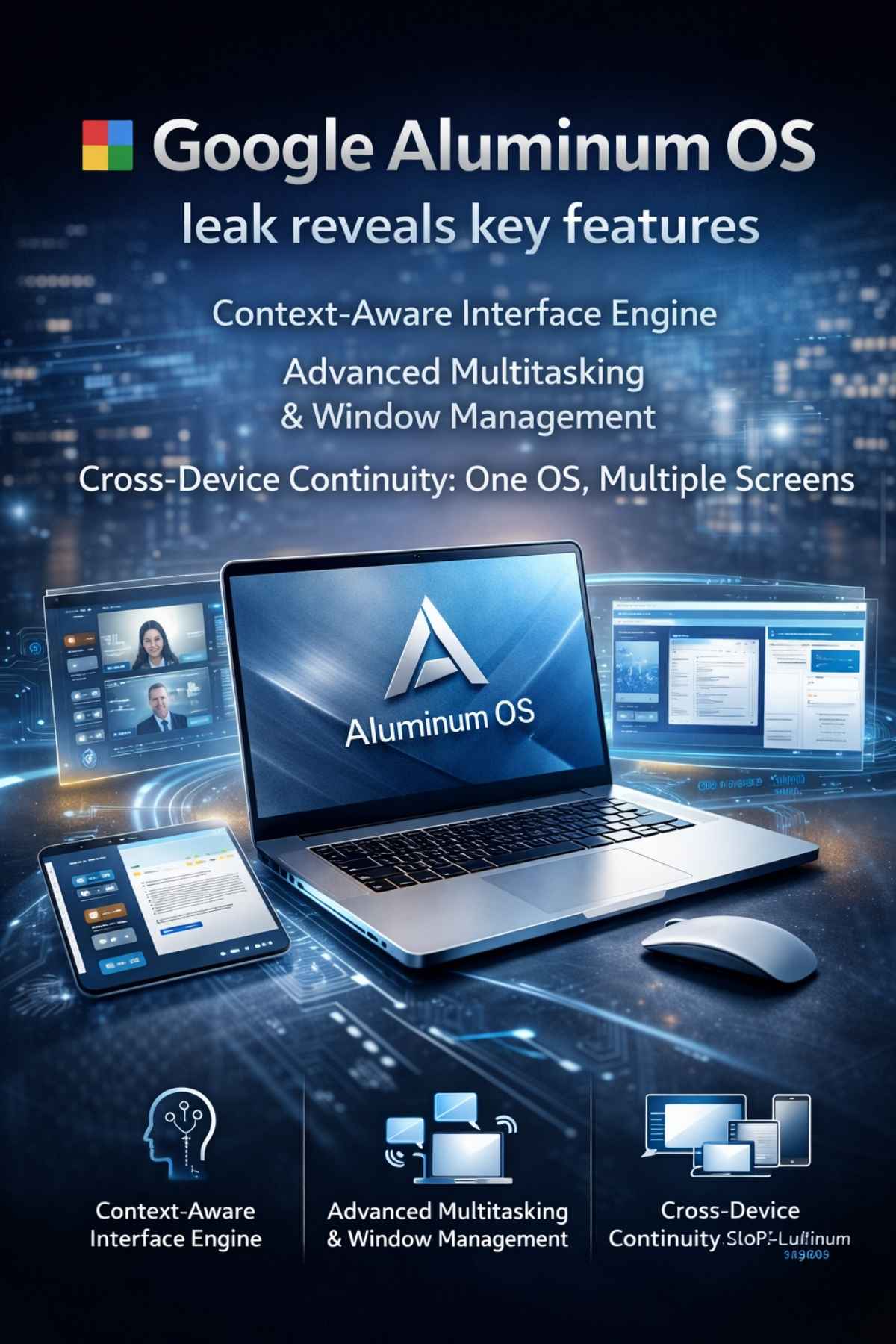
The leaked materials reveal that Google Aluminium OS is not built around flashy visuals alone. Instead, Google appears to be focusing on practical intelligence, system efficiency, and real-world usability.
Below are the most notable features discovered so far.
1. Context-Aware Interface Engine
One of the most impressive innovations in Google Aluminium OS is its context-aware interface engine.
How It Works
The system analyzes:
- Time of day
- Location (on-device)
- User behavior patterns
- App usage history
Based on this data, the interface reorganizes itself in real time.
Real-World Example
- During work hours, productivity apps appear upfront
- At night, the UI shifts toward darker tones and media controls
- While traveling, maps and translation tools become dominant
This makes Google Aluminium OS feel intuitive rather than reactive.
2. Advanced Multitasking & Window Management
The leak confirms a desktop-class multitasking system, especially for tablets, foldables, and laptops.
Key Enhancements
- Resizable floating windows
- Smart split-screen suggestions
- Gesture-based app switching
- App memory persistence
Unlike traditional Android multitasking, Google Aluminium OS maintains state continuity, meaning apps resume exactly where they were left.
3. Cross-Device Continuity: One OS, Multiple Screens
Google Aluminium OS appears to unify Google’s fragmented ecosystem.
Seamless Device Transitions
Users may be able to:
- Start a task on a phone
- Continue on a tablet
- Finish on a laptop or smart display
Notifications, clipboard data, and app states sync instantly.
This positions Google Aluminium OS as a true multi-device operating system, not just a mobile platform.
UI Typography & Motion Design: Subtle but Powerful
The leaked interface highlights refined typography and motion design.
Typography Improvements
- Custom system font optimized for readability
- Better spacing and hierarchy
- Adaptive font scaling
Motion Philosophy
Animations in Google Aluminium OS are:
- Short
- Purpose-driven
- Performance-aware
No unnecessary motion, every transition has a functional role.
AI-Powered Search & System Commands
Search is no longer limited to apps or settings.
Universal AI Search
With Google Aluminium OS:
- Users can type natural language commands
- The system understands intent
- Actions are executed instantly
Example:
“Reduce brightness and open YouTube in split screen”
This command-based interaction reduces dependency on menus and settings.
Battery Optimization: Efficiency at the Core
Battery performance is a major focus of Google Aluminium OS.
Key Battery Features
- Adaptive refresh rates
- App sleep intelligence
- AI-powered background management
Early benchmarks suggest noticeably longer screen-on time, especially on mid-range devices.
Offline Intelligence & On-Device Processing
Privacy-conscious users will appreciate this shift.
Google Aluminium OS emphasizes:
- On-device AI computation
- Reduced cloud dependency
- Faster response times
Tasks like translation, image recognition, and text suggestions run locally whenever possible.
Accessibility Upgrades in Google Aluminium OS
Accessibility has been redesigned from the ground up.
New Accessibility Tools
- AI voice enhancement
- Gesture simplification
- Visual clarity modes
- Cognitive load reduction features
This makes Google Aluminium OS more inclusive and user-friendly.
Customization Without Complexity
Unlike Android’s overwhelming customization options, Google Aluminium OS keeps it simple and smart.
Smart Personalization
- AI suggests themes
- Layouts adapt automatically
- Manual controls remain optional
Users get personalization without micromanagement.
Security Architecture: Built for the AI Era
Security leaks indicate:
- Continuous system monitoring
- Encrypted app containers
- Real-time threat detection
Google Aluminium OS uses AI to detect suspicious behavior before damage occurs.
How Google Aluminium OS Could Replace Multiple Platforms
Industry experts believe Google Aluminium OS could:
- Merge Android and ChromeOS
- Reduce fragmentation
- Simplify updates
This would allow Google to compete more directly with Apple’s unified ecosystem.
User Experience Philosophy Behind Aluminium OS

Google Aluminium OS focuses on:
- Calm design
- Predictive assistance
- Reduced cognitive overload
The goal is to let users focus on tasks, not interfaces.
Google Aluminium OS vs Android, iOS & Windows
One of the biggest questions after the leak is how Google Aluminium OS compares to existing operating systems. Early indicators suggest Google is aiming for a hybrid experience combining the flexibility of Android, the polish of iOS, and the productivity of Windows.
Google Aluminium OS vs Android
While Android remains powerful, it has grown complex over time.
| Aspect | Android | Google Aluminium OS |
| UI Complexity | Feature-heavy | Clean & focused |
| AI Role | Add-on | Core system layer |
| Performance | Hardware-dependent | Optimized across tiers |
| Updates | Fragmented | Unified architecture |
Google Aluminium OS appears designed to solve Android’s fragmentation problem.
Google Aluminium OS vs iOS
Apple’s iOS is known for stability and consistency.
Where Aluminium OS Competes Strongly:
- More system-level AI integration
- Greater multitasking flexibility
- Cross-device continuity beyond Apple hardware
Where iOS Still Leads:
- Hardware-software optimization
- Long-term update reliability
However, Google Aluminium OS could narrow this gap significantly.
Google Aluminium OS vs Windows
Windows dominates productivity, but struggles with touch-first experiences.
Google’s Aluminium OS offers:
- Touch-first design
- Lightweight performance
- AI-driven workflows
This positions it as a modern alternative for casual and hybrid computing.
Market Impact: Why This Leak Matters to the Industry
The Google’s Aluminium OS interface leak suggests Google is repositioning itself in the global OS market.
Potential Industry Shifts
- Pressure on Apple to enhance AI at OS level
- Reduced reliance on third-party skins
- Increased focus on AI-native operating systems
This could influence how future operating systems are designed.
Expected Devices to Support Google Aluminium OS
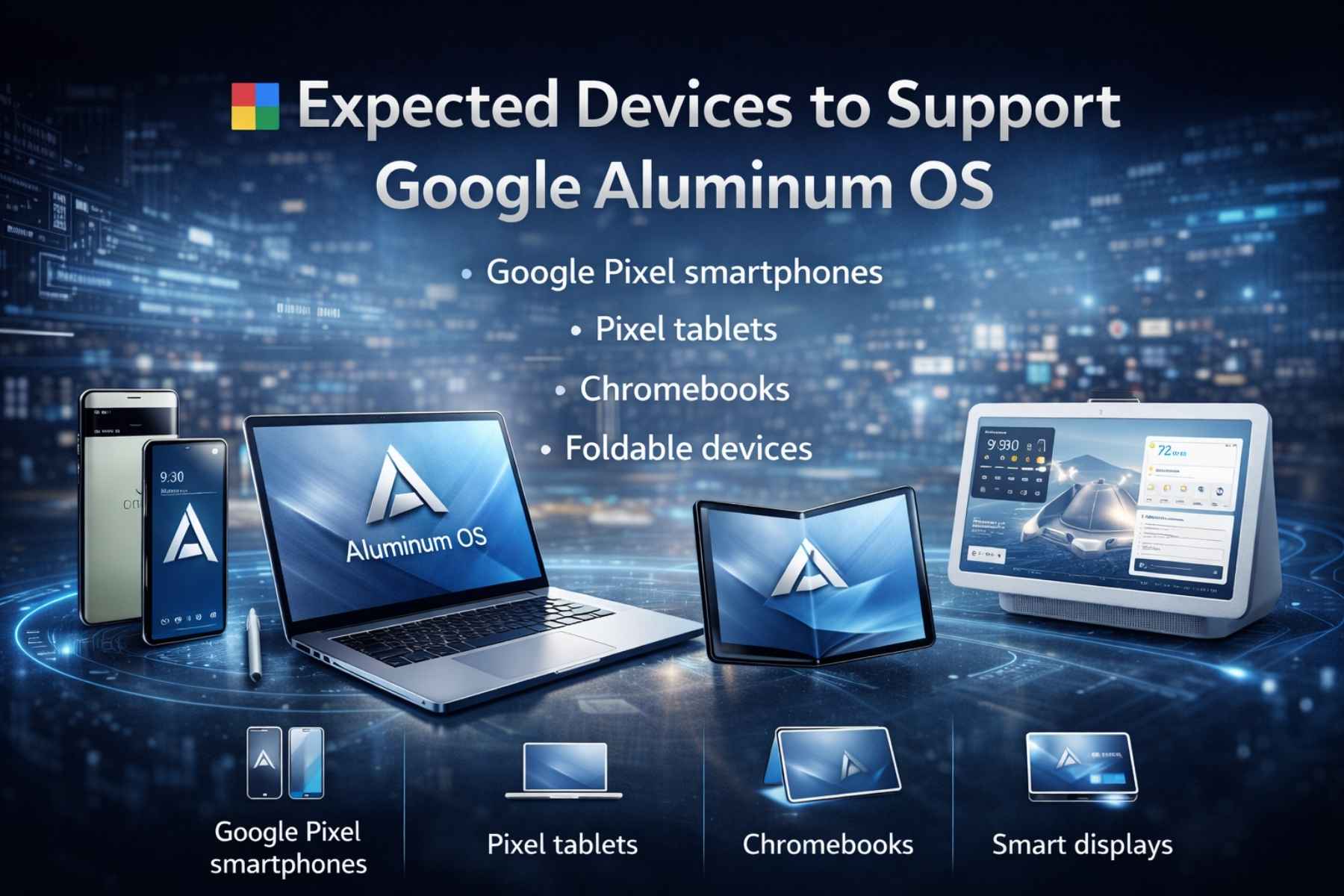
Although Google hasn’t confirmed anything officially, leaks suggest initial support for:
- Google Pixel smartphones
- Pixel tablets
- Chromebooks
- Foldable devices
- Smart displays
Gradual expansion to third-party manufacturers may follow.
Launch Timeline & Rollout Predictions
Based on Google’s development patterns:
- Mid–2026: Developer preview
- Late 2026: Public beta
- Early 2027: Commercial rollout
Google’s Aluminium OS is likely to launch alongside new Pixel hardware.
How Developers Might Benefit from Aluminium OS
Developers could gain:
- Unified APIs
- AI-assisted testing
- Better performance consistency
This reduces development time and improves app stability.
User Adoption Challenges
Despite excitement, Google’s Aluminium OS may face hurdles:
- Learning curve for existing Android users
- App compatibility concerns
- Manufacturer adoption resistance
Google’s execution will determine success.
Why Google Aluminium OS Could Be a Long-Term Play
Rather than chasing trends, Google’s Aluminium OS focuses on:
- Sustainability
- Intelligence
- Ecosystem unification
This indicates a long-term strategic vision, not a short-term experiment.
Expert Opinions & Industry Reactions

Early reactions from analysts describe the leak as:
- “Google’s most ambitious OS move”
- “A necessary evolution beyond Android”
- “AI-first computing done right”
The consensus: Google’s Aluminium OS is worth watching closely.
What Google Aluminium OS Means for the Next Decade
The Google’s Aluminium OS interface leak suggests a fundamental shift in how Google views operating systems. Instead of treating software as a static layer, Google appears to be building a living, adaptive system that grows with the user.
Over the next decade, Google Aluminium OS could:
- Become the foundation of Google’s entire hardware ecosystem
- Power smartphones, tablets, laptops, wearables, and smart environments
- Enable deeper AI-human collaboration
- Reduce dependency on traditional app-based workflows
If executed correctly, Google’s Aluminium OS may redefine how people interact with technology daily.
Why Google Aluminium OS Could Redefine User Expectations
Most operating systems demand attention. Google’s Aluminium OS, by contrast, aims to fade into the background.
Its core philosophy revolves around:
- Calm interfaces
- Predictive assistance
- Reduced friction
- Seamless transitions
This aligns perfectly with modern user behavior, where efficiency and mental clarity matter more than feature overload.
Frequently Asked Questions
What is Google Aluminium OS?
Google Aluminium OS is a leaked next-generation operating system by Google that focuses on a lightweight, AI-native architecture with a redesigned interface and cross-device compatibility.
Is Google Aluminium OS replacing Android?
While not officially confirmed, leaks suggest Google Aluminium OS may unify Android and ChromeOS into a single, streamlined platform.
When will Google Aluminium OS be released?
Based on current leaks and development timelines, Google Aluminium OS is expected to enter preview stages in 2026, with a broader release possibly in 2027.
Which devices will support Google Aluminium OS?
Initial support is likely for Google Pixel devices, tablets, Chromebooks, and foldables, with expansion to other manufacturers later.
How is Google Aluminium OS different from Android?
Google Aluminium OS offers deeper AI integration, improved multitasking, better performance efficiency, and a cleaner, more adaptive interface compared to Android.
Does Google Aluminium OS improve battery life?
Yes, the OS emphasizes intelligent background management, adaptive refresh rates, and on-device AI processing to enhance battery performance.
Is Google Aluminium OS secure?
Leaked information suggests advanced AI-driven security, encrypted app containers, and real-time threat detection mechanisms.
Will apps need to be rebuilt for Google Aluminium OS?
Most Android apps are expected to work, but developers may optimize apps to fully leverage the OS’s modular and AI-driven features.
How does Google Aluminium OS use AI?
AI is integrated at the system level, powering UI adjustments, smart search, multitasking predictions, battery optimization, and accessibility features.
Can Google Aluminium OS compete with Apple and Microsoft?
Yes. With strong AI integration, cross-device continuity, and lightweight performance, Google’s Aluminium OS has the potential to compete globally with iOS and Windows.
Conclusion
The Google’s Aluminium OS interface leak offers more than just early visuals, it reveals Google’s long-term vision for intelligent computing.
By combining:
- Minimalist design
- AI-first architecture
- Cross-device fluidity
- Performance efficiency
Google’s Aluminium OS positions itself as a serious contender in the next generation of operating systems.
While many details remain unconfirmed, one thing is clear: Google’s Aluminium OS is not a minor update it is a strategic evolution.
If Google delivers on its promises, this OS could reshape the global tech landscape and redefine how billions of users experience digital life.
Explore More: Tech News Today: Latest AI, Smartphones & Gadgets Updates