The Stock Market is one of the most talked-about financial topics around the world. Whether you are watching the news, scrolling social media, or listening to financial podcasts, you’ll often hear about stock prices, investments, and market trends. But what exactly is the Stock Market, and why is it so important for individuals and businesses alike?
For beginners, the Stock Market can seem complicated and intimidating. Terms like “shares,” “indices,” “bull market,” and “bear market” might feel overwhelming at first. This guide will break it down into simple, easy-to-understand language so that even someone with no prior knowledge can grasp the basics.
By the end of this article, you will understand what the Stock Market is, how it works, why it matters, and how you can start learning about investing safely in 2026. This is a complete beginner-friendly guide designed to give you confidence and clarity.
Why You Should Care About the Stock Market
Imagine this: You have some extra money saved, and you want it to grow over time. Instead of keeping it in a bank account with minimal interest, you could make your money work for you. This is where the Stock Market comes in.
Investing in the Stock Market has created countless millionaires, but more importantly, it allows ordinary people to grow their wealth steadily. Understanding the Stock Market is no longer just for financial experts today, anyone can participate with the right knowledge and approach.
In 2026, technology has made the Stock Market more accessible than ever. You can now research stocks, buy shares, and track market trends from your smartphone. Learning the fundamentals now can set you up for financial growth and smarter money decisions.
What is the Stock Market?

At its core, the Stock Market is a platform where people buy and sell shares of companies. When you buy a share, you own a small piece of that company. The Stock Market serves as a bridge between companies that need capital to grow and investors who want to earn returns on their money.
Key points to understand about the Stock Market:
- Ownership in Companies: Each share represents a fraction of ownership in a company.
- Trading: Shares are bought and sold on stock exchanges like the New York Stock Exchange (NYSE) or NASDAQ.
- Price Fluctuations: Stock prices change based on demand, company performance, market trends, and global events.
- Wealth Creation: Historically, investing in the Stock Market has been one of the most effective ways to build wealth over time.
History of the Stock Market
Understanding the Stock Market also requires a brief look at its history:
- 17th Century: The first formal stock exchange was established in Amsterdam in 1602, allowing investors to buy shares of the Dutch East India Company.
- 18th-19th Century: Stock trading spread to London and New York, becoming a vital part of the global economy.
- 20th Century: Stock markets became more regulated, with governments implementing rules to protect investors and ensure fairness.
- 21st Century: Technology transformed the Stock Market, enabling online trading, real-time tracking, and access for individual investors worldwide.
The Stock Market has evolved from a simple marketplace to a complex, global financial ecosystem, but the basic principles of buying and selling shares remain the same.
How the Stock Market Works
Understanding how the Stock Market works is essential for beginners:
- Companies Go Public: A company sells shares through an Initial Public Offering (IPO) to raise capital.
- Investors Buy Shares: Investors purchase these shares, becoming partial owners.
- Trading on Exchanges: Shares are traded on stock exchanges. Prices fluctuate based on supply and demand.
- Earnings and Dividends: Companies may pay dividends to shareholders, providing a regular income in addition to capital gains.
- Market Influences: Stock prices are influenced by economic indicators, company performance, investor sentiment, and global events.
The Stock Market essentially reflects the collective sentiment of millions of investors. When more people want to buy a stock, its price rises. When more want to sell, the price falls.
Types of Stock Markets
The Stock Market is generally divided into two types:
- Primary Market: Where companies sell shares for the first time (IPOs).
- Secondary Market: Where investors trade shares among themselves. Examples include the NYSE, NASDAQ, London Stock Exchange, and other global exchanges.
Both markets work together to provide liquidity and growth opportunities for investors and companies.
Types of Stocks
In the Stock Market, not all shares are the same. Understanding the different types of stocks helps beginners choose the right investments. Here are the main types:
1. Common Stocks
- Most investors buy common stocks.
- Owners get voting rights in company decisions (like board member elections).
- Profit comes from capital gains (selling shares at a higher price than purchased) and sometimes dividends.
2. Preferred Stocks
- Less common for beginner investors.
- Preferred stockholders receive dividends before common stockholders.
- Usually, preferred stocks do not have voting rights.
- They offer more stable income but limited growth potential.
3. Growth Stocks
- Companies expected to grow faster than the market.
- They usually reinvest profits instead of paying high dividends.
- Ideal for investors looking for long-term capital gains.
4. Dividend Stocks
- Companies that pay regular dividends to shareholders.
- Often large, established companies with stable earnings.
- Best for investors looking for regular income in addition to potential growth.
5. Blue-Chip Stocks
- Stocks of well-established, financially stable companies.
- Considered safer investments in the Stock Market.
- Often pay consistent dividends and are part of major market indices like the S&P 500.
How to Invest in the Stock Market
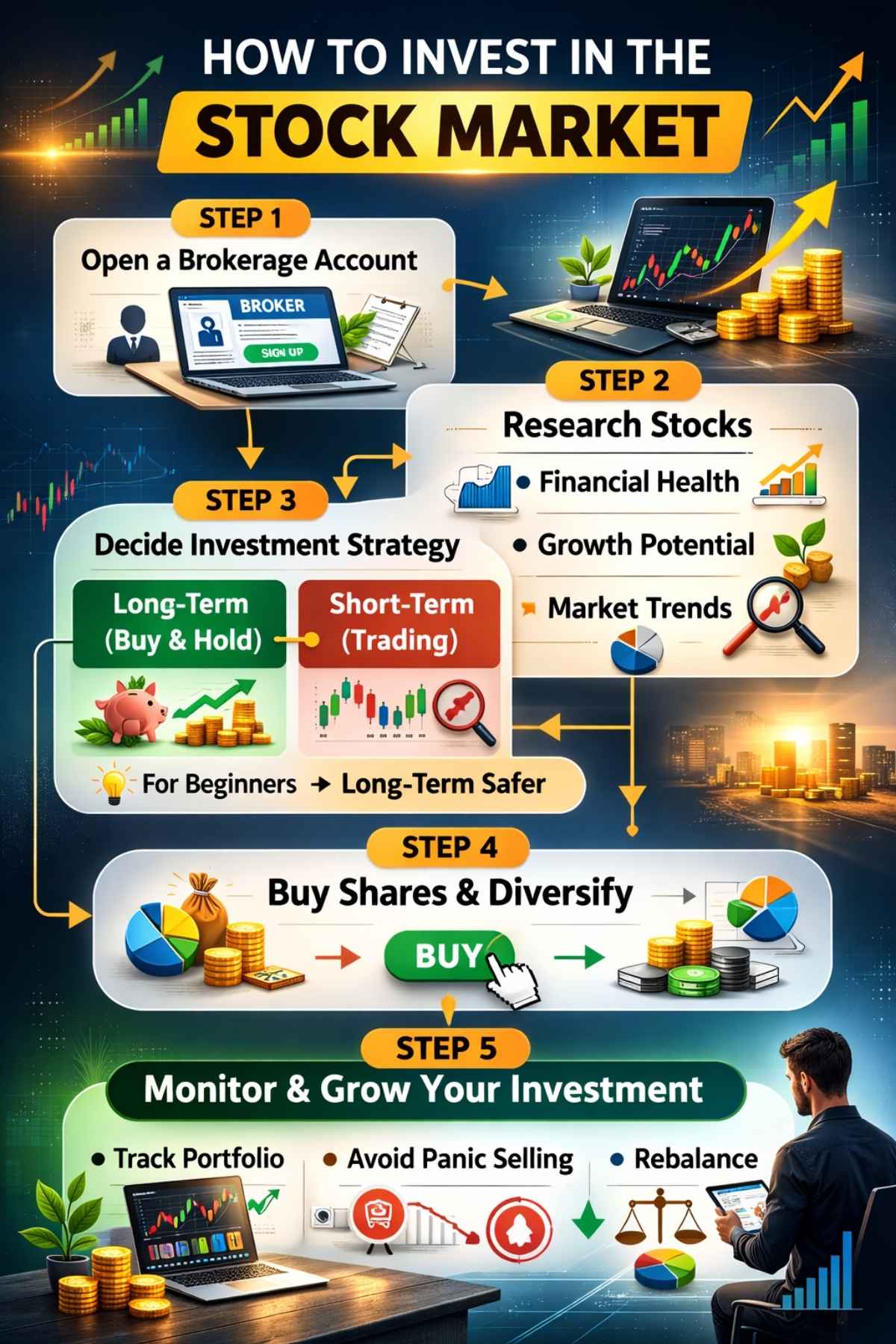
For beginners, investing in the Stock Market might feel intimidating, but it’s easier than it seems. Here’s a step-by-step guide:
Step 1: Open a Brokerage Account
- A brokerage account is needed to buy and sell stocks.
- Choose a reliable broker with low fees, good research tools, and a user-friendly platform.
Step 2: Research Stocks
- Study the company’s financial health, growth potential, and market trends.
- Use tools like financial statements, earnings reports, and analyst ratings.
Step 3: Decide Investment Strategy
- Long-term investing: Buy and hold for years, relying on growth and dividends.
- Short-term trading: Buy and sell quickly to take advantage of market fluctuations (riskier).
- For beginners, long-term investing is usually safer.
Step 4: Buy Shares
- Decide how many shares to buy and at what price.
- Diversify your portfolio to reduce risk. Don’t put all your money into one stock.
Step 5: Monitor Your Investments
- Regularly check your portfolio but avoid panic selling during short-term market drops.
- Rebalance your portfolio occasionally to match your goals and risk tolerance.
Stock Market Indices
A stock market index measures the performance of a group of stocks, giving investors an idea of the overall market trend.
Popular Stock Market Indices:
- S&P 500: Tracks 500 large U.S. companies, considered a benchmark for the American market.
- Dow Jones Industrial Average (DJIA): Tracks 30 major U.S. companies, showing market health.
- NASDAQ Composite: Focuses on tech companies, like Apple and Microsoft.
- FTSE 100: UK-based index tracking 100 largest companies.
- Nikkei 225: Japanese index tracking 225 top companies.
Understanding indices helps investors track market trends, even if they don’t own all the stocks in the index.
Key Participants in the Stock Market
The Stock Market involves several types of participants, each playing a crucial role:
1. Investors
- Individuals or institutions who buy stocks to grow wealth over time.
- Can be retail investors (small investors) or institutional investors (banks, mutual funds, hedge funds).
2. Traders
- Focus on short-term profits, buying and selling quickly.
- Use charts, trends, and technical analysis to make decisions.
3. Brokers
- Act as intermediaries between investors and the stock exchange.
- Charge a commission or fee for their services.
4. Stock Exchanges
- The marketplace where shares are traded, like NYSE, NASDAQ, and London Stock Exchange.
- Ensure fair trading and transparency.
5. Regulators
- Government agencies, like the SEC (Securities and Exchange Commission), oversee the market to protect investors and prevent fraud.
Risks of the Stock Market
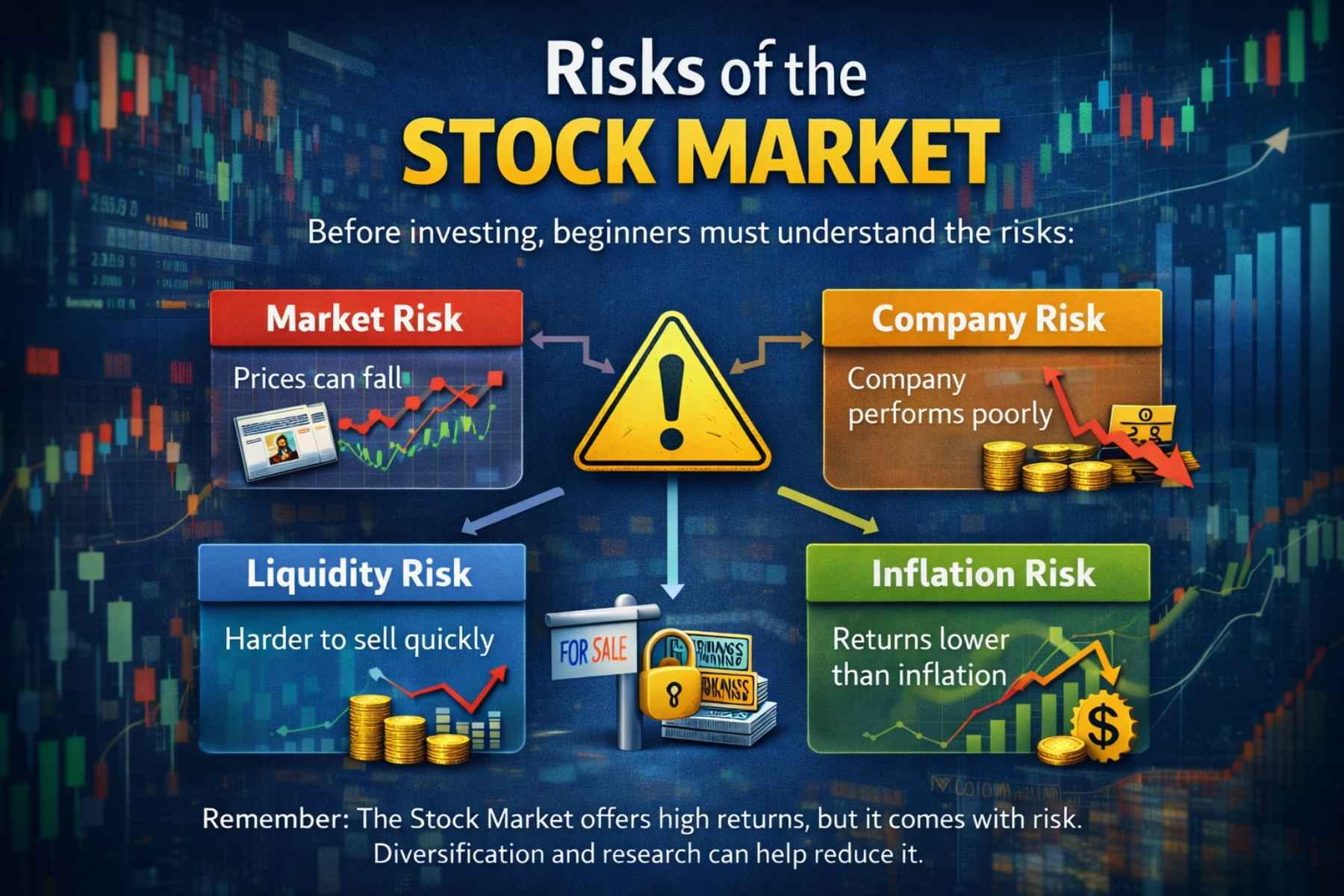
Before investing, beginners must understand the risks:
- Market Risk: Prices can fall due to economic changes or global events.
- Company Risk: A company may perform poorly, affecting stock value.
- Liquidity Risk: Some stocks are harder to sell quickly.
- Inflation Risk: Returns might be lower than inflation over time.
Remember: The Stock Market offers high returns, but it comes with risk. Diversification and research can help reduce it.
Beginner-Friendly Stock Market Strategies
Investing in the Stock Market isn’t just about buying any stock randomly. Successful investors use strategies to minimize risk and maximize returns. Here are beginner-friendly strategies:
1. Buy and Hold Strategy
- Buy quality stocks and hold them for the long term.
- Takes advantage of compounding growth over years.
- Reduces stress from daily market fluctuations.
2. Dollar-Cost Averaging
- Invest a fixed amount regularly, regardless of market price.
- Reduces the impact of market volatility.
- Example: Investing $100 every month in a particular stock or ETF.
3. Diversification
- Don’t put all your money in one stock or sector.
- Spread investments across different industries, countries, and asset types.
- Reduces risk and stabilizes returns over time.
4. Dividend Investing
- Focus on stocks that pay consistent dividends.
- Provides passive income in addition to potential growth.
- Ideal for conservative investors.
5. Index Fund Investing
- Instead of picking individual stocks, invest in index funds that track major indices like S&P 500.
- Lower fees, diversified portfolio, and historically stable returns.
How to Read Stock Charts
Stock charts help investors understand price movements and make informed decisions. Beginners should focus on these basics:
1. Line Charts
- Shows closing prices over time.
- Simple and ideal for beginners to see trends.
2. Bar Charts
- Shows opening, closing, high, and low prices for a stock in a period.
- Gives more detail than line charts.
3. Candlestick Charts
- Shows price range, opening, closing, highs, and lows visually.
- Green candlesticks indicate price increase, red indicates price decrease.
4. Reading Trends
- Uptrend: Stock consistently increases in value.
- Downtrend: Stock consistently decreases in value.
- Sideways/Flat trend: Stock moves within a narrow range.
5. Support and Resistance
- Support level: Price level where stock tends to stop falling.
- Resistance level: Price level where stock tends to stop rising.
- Helps in deciding when to buy or sell.
Market Trends and Indicators
Understanding market trends and indicators helps beginners predict potential movements in the Stock Market.
Key Indicators:
- Moving Averages (MA): Shows average stock price over a specific period. Smooths out fluctuations.
- Relative Strength Index (RSI): Measures whether a stock is overbought or oversold.
- Volume: Shows how many shares are traded. High volume often indicates strong market interest.
- Economic Indicators: GDP growth, unemployment rates, and inflation affect the Stock Market.
- Market Sentiment: Investor confidence and news events can drive stock prices up or down.
Common Stock Market Mistakes Beginners Should Avoid
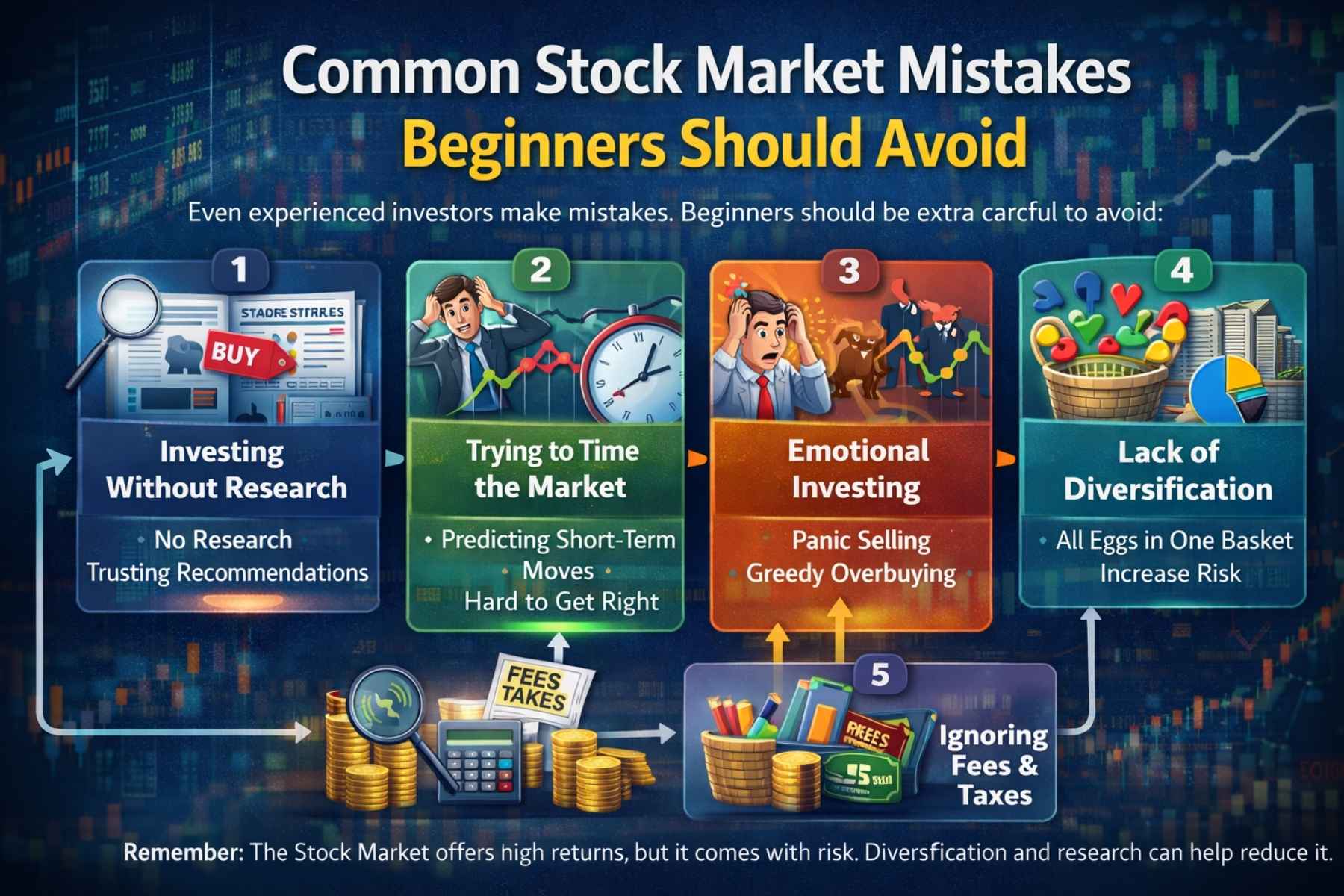
Even experienced investors make mistakes. Beginners should be extra careful to avoid:
1. Investing Without Research
- Never buy stocks just because someone recommends them.
- Study company fundamentals and industry trends.
2. Trying to Time the Market
- Avoid attempting to predict short-term market movements.
- Even experts struggle to time the market perfectly.
3. Emotional Investing
- Fear and greed often lead to panic selling or overbuying.
- Stick to your investment plan and strategy.
4. Lack of Diversification
- Putting all money in one stock increases risk.
- Diversify across sectors and asset classes.
5. Ignoring Fees and Taxes
- Brokerage fees, transaction costs, and taxes can reduce returns.
- Always account for them when investing.
Tools for Stock Market Beginners
Several tools can help beginners manage investments efficiently:
- Brokerage Apps: For buying, selling, and tracking stocks.
- Financial News Platforms: Stay updated with market news.
- Stock Screeners: Filter stocks based on performance, industry, or price.
- Investment Calculators: Track growth projections over time.
- Learning Resources: Books, courses, and online tutorials to understand fundamentals.
Advanced Tips for Stock Market Beginners
Once you understand the basics, applying some advanced strategies can help you invest more wisely:
1. Set Clear Financial Goals
- Decide why you are investing: retirement, education, buying a home, or wealth growth.
- Define your time horizon and risk tolerance.
- Goals help you choose suitable stocks and investment strategies.
2. Use a Balanced Portfolio
- Combine stocks, bonds, ETFs, and mutual funds.
- Reduces risk and ensures growth potential even during market downturns.
3. Focus on Quality Over Quantity
- It’s better to invest in a few high-quality stocks than spread money too thin.
- Quality stocks often have strong earnings, growth potential, and stability.
4. Stay Informed, Not Overloaded
- Read financial news but avoid constant panic over short-term changes.
- Follow trusted sources and official company reports.
5. Practice Patience
- The Stock Market rewards long-term investors.
- Avoid making quick decisions based on emotions or hype.
Common Stock Market Myths
Many beginners believe myths that can lead to mistakes. Here are some common misconceptions:
Myth 1: Stock Market is Only for Experts
- Reality: Beginners can invest successfully with proper research and strategy.
Myth 2: You Need a Lot of Money to Start
- Reality: Many brokers allow starting with small amounts, even $50 or $100.
Myth 3: Investing in Stocks is Gambling
- Reality: Unlike gambling, investing is based on research, analysis, and strategy.
Myth 4: High Returns Are Guaranteed
- Reality: The Stock Market is risky, and no investment guarantees returns.
Myth 5: You Should Sell When Prices Drop
- Reality: Short-term drops are normal; selling in panic can lead to losses.
How to Protect Your Investments
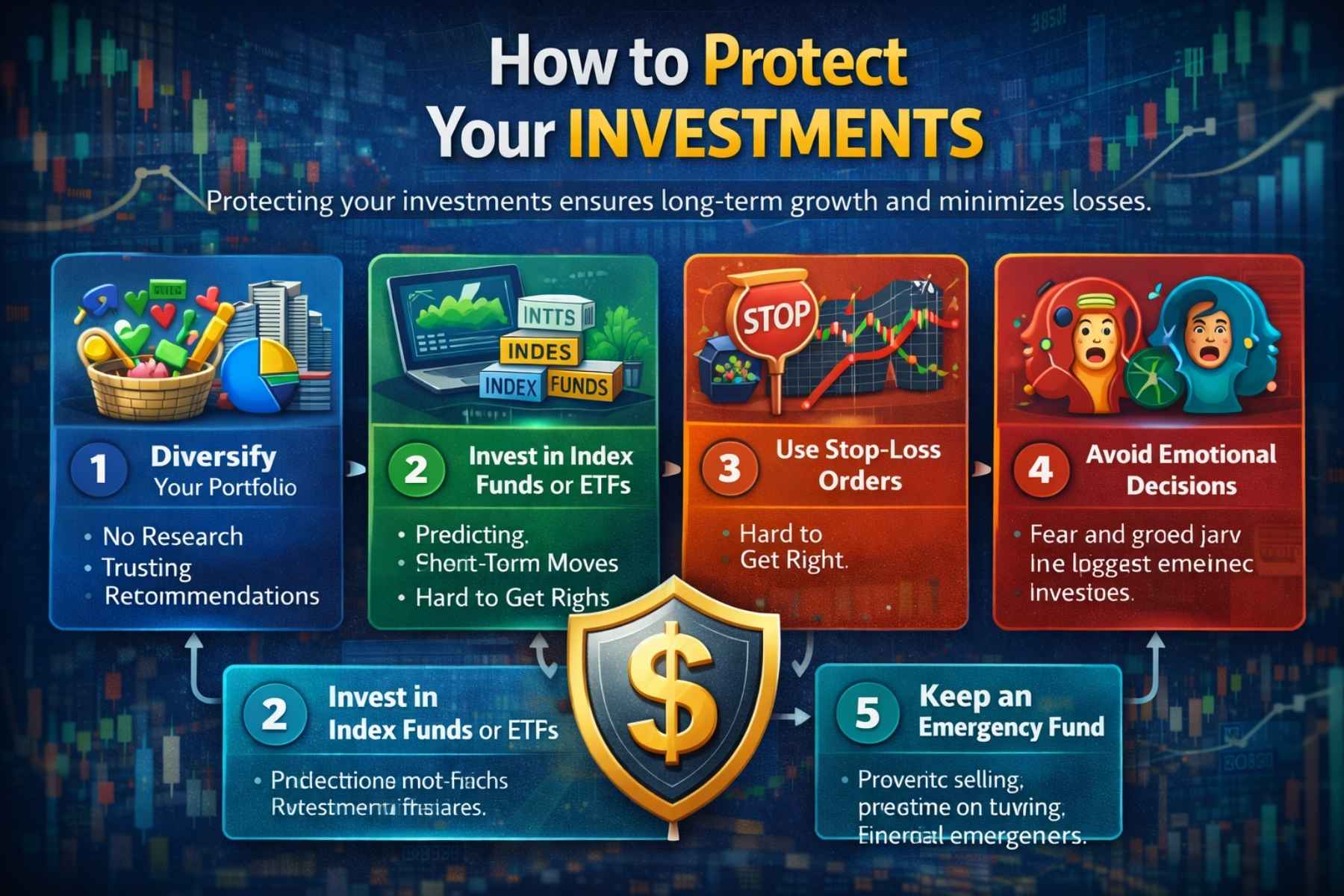
Protecting your investments ensures long-term growth and minimizes losses.
1. Diversify Your Portfolio
- Don’t rely on a single stock, sector, or country.
- Diversification reduces the impact of poor-performing stocks.
2. Invest in Index Funds or ETFs
- Index funds track major market indices, providing low-risk exposure.
3. Use Stop-Loss Orders
- Set a limit to automatically sell a stock if it falls below a certain price.
- Helps prevent huge losses during sudden market downturns.
4. Avoid Emotional Decisions
- Fear and greed are the biggest enemies of investors.
- Stick to your investment plan and long-term goals.
5. Keep an Emergency Fund
- Before investing, have 3-6 months of expenses saved.
- Prevents selling investments during financial emergencies.
Real-Life Examples of Stock Market Success
1. Warren Buffett – The Oracle of Omaha
- Started investing in his teens and built billions using long-term investing and value investing strategies.
2. Peter Lynch – Fidelity Magellan Fund
- Focused on understanding companies and investing in what he knew.
- Achieved an average annual return of 29% over 13 years.
3. Global Index Fund Investors
- People who invested in S&P 500 index funds in the long term have grown wealth steadily.
- Demonstrates the power of compounding and patience.
These examples show that with knowledge, strategy, and discipline, anyone can benefit from the Stock Market, even as a beginner.
Frequently Asked Questions
1. What is the Stock Market?
The Stock Market is a platform where companies sell shares to investors, and investors buy or sell these shares. It allows companies to raise capital and investors to potentially grow wealth.
2. How much money do I need to start investing in the Stock Market?
You can start with small amounts, often as low as $50–$100, depending on your broker. Many platforms now allow fractional share investing for beginners.
3. Is the Stock Market risky?
Yes, all investments involve risk. Prices fluctuate due to company performance, economic conditions, and global events. Risk can be reduced with research, diversification, and a long-term strategy.
4. How can I start investing as a beginner?
- Open a brokerage account.
- Research companies or funds.
- Decide your strategy (long-term or short-term).
- Invest small amounts regularly.
- Monitor your investments but avoid emotional decisions.
5. What are dividends?
Dividends are payments made by companies to shareholders, usually from profits. Dividend-paying stocks can provide regular passive income.
6. Should I try to time the market?
Beginners are advised not to time the market, as predicting short-term price movements is extremely difficult. Long-term investing is generally safer and more effective.
7. How do I protect my investments?
- Diversify across sectors and asset classes.
- Use index funds or ETFs.
- Set stop-loss orders.
- Avoid emotional decisions and keep an emergency fund.
Conclusion
The Stock Market may seem complex at first, but with knowledge and a disciplined approach, it can become a powerful tool for wealth creation. By understanding:
- Types of stocks
- How to invest
- Market trends and indicators
- Risks and protective strategies
Beginners can confidently start their journey in investing.
In 2026, the Stock Market is more accessible than ever, offering opportunities for everyone, from students to professionals, to grow their money. The key is education, patience, and consistency. Start small, stay informed, and invest wisely, and over time, you can achieve financial growth and security.
Disclaimer
The information provided in this article is for educational purposes only and does not constitute financial advice. Investing in the Stock Market involves risk, and past performance is not indicative of future results. Readers should conduct their own research or consult a licensed financial advisor before making any investment decisions.
Explore More: What is Cryptocurrency? Complete Beginner Guide (2026)