When innovation meets real business needs, technology stops being a luxury and becomes a competitive advantage. That is exactly what happened at MWC 2026, where Lenovo introduced a bold new generation of intelligent enterprise hardware designed to reshape modern workplaces. The announcement of Lenovo AI Business Devices marks a strategic shift in how companies approach computing, automation, and productivity in an AI-driven era.
This is not just another hardware refresh. It represents a transformation in enterprise computing philosophy from reactive systems to predictive, adaptive, and self-optimizing business tools.
A Defining Moment for Business Computing
Artificial intelligence is no longer experimental. It is embedded in daily workflows, decision-making systems, cybersecurity frameworks, and collaboration platforms. However, most businesses still rely on traditional computing infrastructure that was never designed for AI-native operations.
With the unveiling of Lenovo AI Business Devices, the company has signaled that enterprise hardware must evolve to match AI software advancements. Instead of depending entirely on cloud processing, these new systems integrate on-device AI acceleration, enterprise-grade security layers, and intelligent power management.
The result? Faster performance, lower latency, improved data privacy, and smarter workflows all optimized for modern organizations operating across hybrid and remote environments.
The Vision Behind Lenovo’s AI Strategy
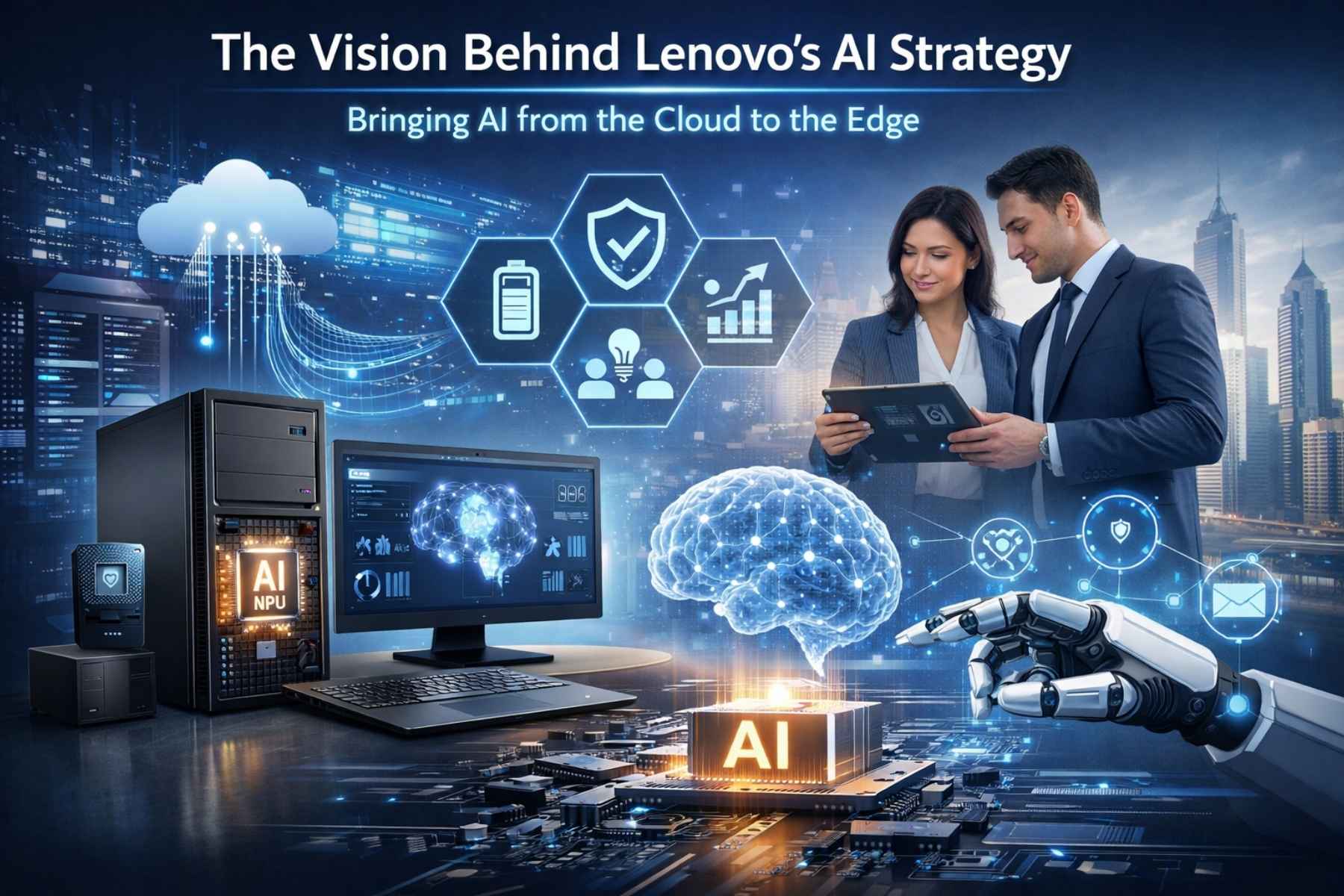
The launch of Lenovo AI Business Devices is rooted in a broader vision: bringing AI from the cloud to the edge.
For years, businesses have relied heavily on centralized cloud processing. While effective, this approach introduces latency, bandwidth dependency, and potential security exposure. Lenovo’s strategy focuses on integrating dedicated AI processing units (NPUs) directly into business laptops, desktops, and workstations.
This architecture allows:
- Real-time AI-assisted analytics
- Intelligent battery optimization
- Automated security threat detection
- Context-aware collaboration enhancements
- Workflow prediction and resource allocation
By embedding AI at the hardware level, Lenovo AI Business Devices are designed to function as proactive business partners rather than passive tools.
What Was Announced at MWC 2026?
At MWC 2026, Lenovo showcased a complete portfolio under its AI-powered enterprise category. The announcement included:
1. AI-Enhanced Business Laptops
Designed for executives, remote teams, and enterprise professionals, these systems include:
- Integrated AI co-processors
- Smart background noise elimination
- AI-driven meeting summarization
- Biometric-enhanced security authentication
- Adaptive display and battery performance
2. AI Workstations for Data-Intensive Tasks
For engineers, designers, financial analysts, and AI developers, the workstations in the Lenovo AI Business Devices lineup deliver:
- Dedicated neural processing acceleration
- Advanced thermal intelligence
- Real-time rendering optimization
- Machine learning workload balancing
3. Enterprise Desktops with AI Optimization
These systems are tailored for corporate environments that require:
- Predictive maintenance alerts
- Intelligent resource distribution
- AI-driven system diagnostics
- Automated firmware protection
Each category demonstrates how Lenovo is aligning hardware innovation with enterprise AI adoption.
Why This Announcement Matters Globally
The introduction of Lenovo AI Business Devices at one of the world’s largest technology exhibitions signals an industry-wide shift. Businesses across North America, Europe, Asia-Pacific, and emerging markets are accelerating digital transformation strategies.
Key global drivers include:
- The rise of AI-driven customer service platforms
- Remote and hybrid workforce expansion
- Increasing cybersecurity threats
- Demand for energy-efficient infrastructure
- Regulatory pressure around data privacy
Traditional business hardware cannot efficiently handle these demands without significant upgrades. Lenovo’s AI-integrated approach addresses these challenges by reducing reliance on external computing resources and improving system intelligence internally.
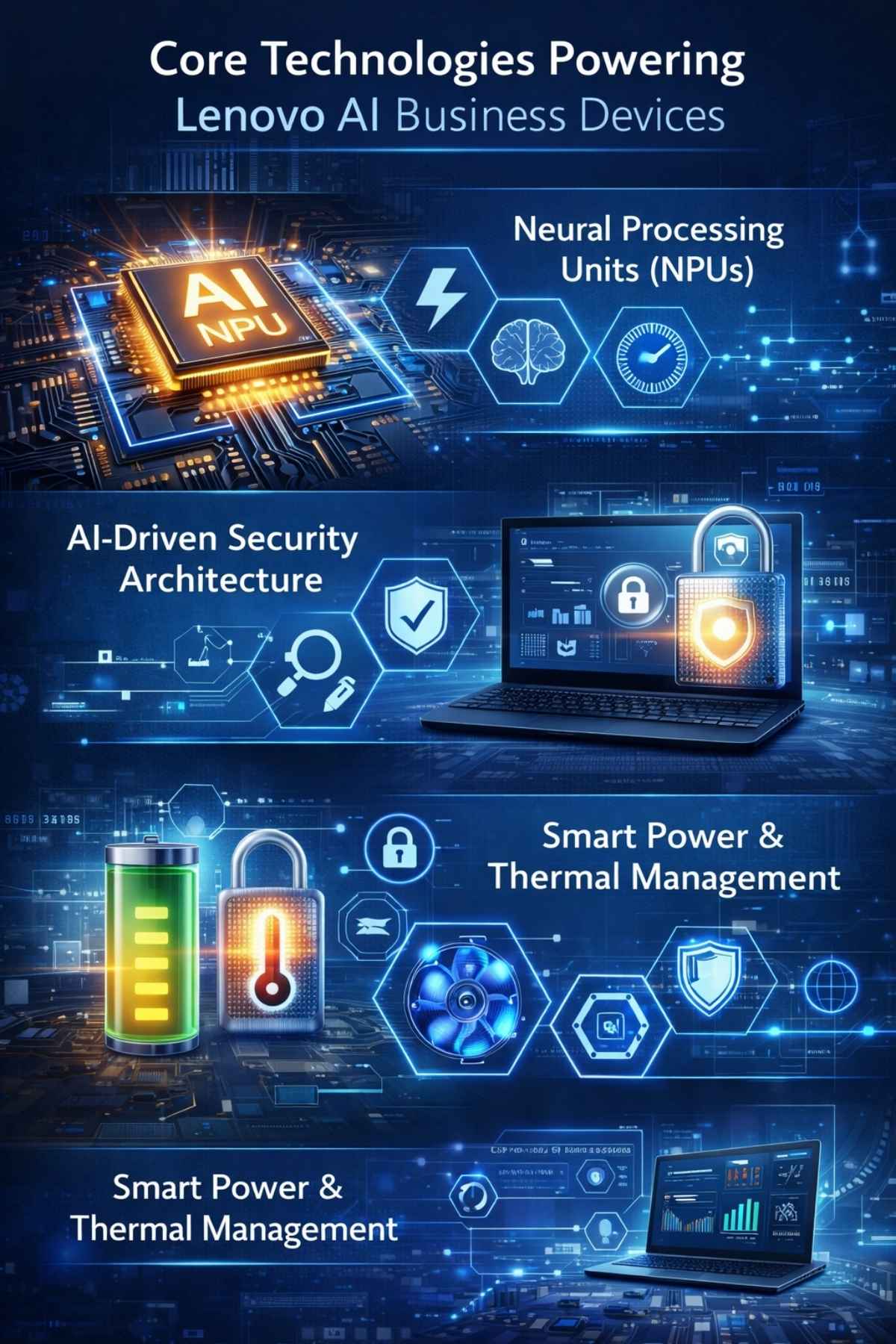
Core Technologies Powering Lenovo AI Business Devices
1. Neural Processing Units (NPUs)
One of the most significant upgrades in Lenovo AI Business Devices is the integration of NPUs. These specialized processors handle AI workloads separately from the CPU and GPU, enabling:
- Faster AI inference
- Reduced power consumption
- Lower system latency
- Improved multitasking stability
This ensures AI features operate seamlessly in the background without compromising overall system performance.
2. AI-Driven Security Architecture
Cybersecurity remains one of the top concerns for enterprises worldwide. Lenovo’s latest portfolio integrates AI-based threat detection systems capable of identifying unusual behavior patterns in real time.
Key capabilities include:
- Behavioral anomaly detection
- Self-healing BIOS systems
- AI-assisted encryption management
- Intelligent phishing protection
With cyberattacks becoming increasingly sophisticated, Lenovo AI Business Devices prioritize proactive defense rather than reactive security.
3. Smart Power & Thermal Management
Energy efficiency is not just about battery life; it is about sustainable enterprise infrastructure. Lenovo’s AI algorithms analyze user behavior and workload intensity to optimize:
- CPU and GPU allocation
- Display brightness adjustments
- Cooling fan activity
- Background process prioritization
This results in longer battery performance for mobile professionals and reduced energy consumption for large enterprises deploying hundreds or thousands of systems.
Human-Centered AI: Beyond Performance
While technical specifications matter, user experience ultimately defines productivity. The new Lenovo AI Business Devices are built with human-centered AI principles.
This includes:
- Real-time transcription during meetings
- AI-generated action summaries
- Automatic camera framing in video calls
- Voice clarity enhancement
- Context-based workflow suggestions
Instead of overwhelming users with complexity, these devices simplify tasks and reduce cognitive load allowing professionals to focus on strategy and creativity.
Early Market Reaction
Initial reactions from industry analysts suggest that Lenovo’s announcement could accelerate enterprise AI hardware adoption significantly. Businesses are actively seeking scalable AI-ready systems, and the introduction of Lenovo AI Business Devices aligns with that demand.
Technology consultants highlight three main advantages:
- Reduced cloud dependency
- Improved on-device data privacy
- Lower long-term infrastructure costs
If adoption trends follow current AI investment growth, Lenovo’s enterprise AI portfolio may become a benchmark for next-generation corporate computing standards.
Hardware Architecture: Built for the AI-First Era
The core strength of Lenovo AI Business Devices lies in their AI-native architecture. Unlike traditional business laptops and desktops that simply run AI software, these systems are engineered to execute AI workloads efficiently at the silicon level.
1. Hybrid Processing Model
The new lineup follows a hybrid compute architecture consisting of:
- High-performance CPUs for general computing
- Advanced GPUs for graphical and parallel workloads
- Dedicated NPUs (Neural Processing Units) for AI tasks
This three-tier model ensures AI operations such as transcription, predictive analytics, security scanning, and workflow automation do not interfere with primary tasks like presentations, financial modeling, or software development.
By distributing workloads intelligently, Lenovo AI Business Devices deliver smoother multitasking and higher stability during peak enterprise usage.
Performance Benchmarks: What Businesses Can Expect
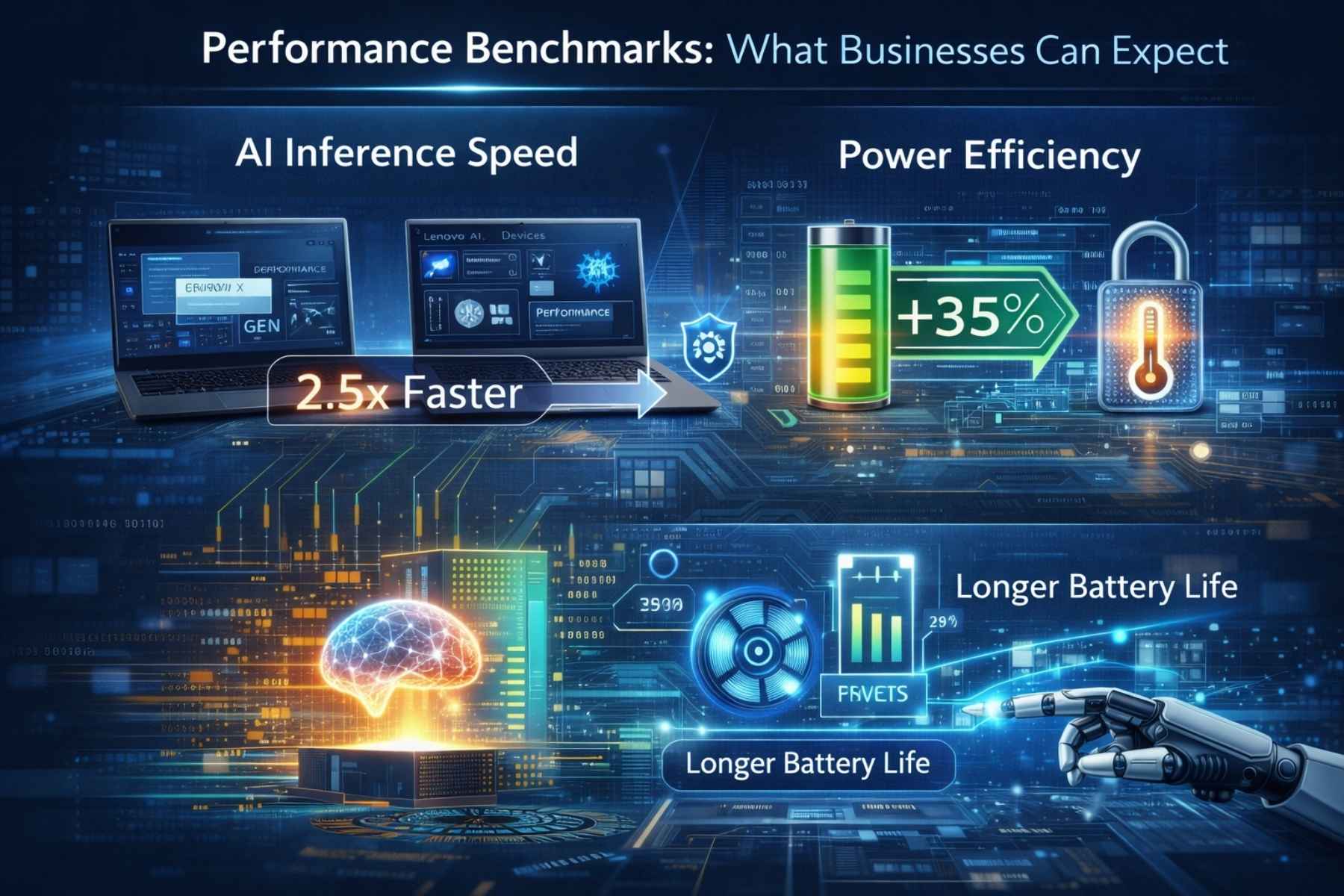
While exact benchmark numbers vary by configuration, early demonstrations at MWC 2026 showed measurable improvements in AI-heavy scenarios.
AI Inference Speed
On-device AI inference tasks including natural language summarization and background image processing performed significantly faster compared to previous enterprise generations. This reduces reliance on cloud calls and enhances data privacy.
Power Efficiency
Thanks to the NPU offloading model:
- AI tasks consume up to 30–40% less power
- Battery life improves during AI-assisted meetings
- Heat generation is minimized
For global enterprises managing thousands of devices, this energy optimization can translate into substantial operational savings.
Enterprise Security: AI as a Defense Layer
Cybersecurity threats are evolving rapidly. Ransomware, AI-generated phishing attacks, and insider threats now require smarter defense mechanisms.
The security framework embedded within Lenovo AI Business Devices integrates predictive AI analysis to monitor behavior patterns in real time.
Intelligent Threat Monitoring
Instead of waiting for known virus signatures, the system identifies:
- Unusual file access behavior
- Suspicious login attempts
- Abnormal data transfers
- Hidden background processes
If irregularities are detected, the device can isolate threats before major damage occurs.
Self-Healing Firmware
Lenovo’s secure BIOS architecture includes automated integrity checks. If unauthorized firmware changes are detected, the system can restore itself to a secure state minimizing downtime and IT intervention.
For multinational corporations, this proactive approach reduces security management complexity.
AI-Powered Collaboration Tools
Hybrid work has permanently changed enterprise communication. AI integration in collaboration tools is no longer optional, it is expected.
Lenovo AI Business Devices enhance virtual meetings with:
- Automatic noise cancellation
- AI-based background enhancement
- Smart camera framing
- Real-time language transcription
- Instant meeting summaries
This improves productivity by eliminating manual note-taking and reducing communication errors.
For executives and project managers, time saved during meetings can directly impact operational efficiency.
Adaptive Performance Management
One standout feature in the new lineup is context-aware optimization. The system studies user behavior patterns over time.
For example:
- If a finance professional consistently uses heavy spreadsheet models at 10 AM, the system pre-allocates CPU power accordingly.
- If a designer runs rendering software in the afternoon, GPU allocation adjusts dynamically.
This behavioral learning engine ensures Lenovo AI Business Devices become more efficient the longer they are used.
Sustainability & Green Computing Strategy
Environmental responsibility is becoming a global business priority. Lenovo has aligned its AI enterprise portfolio with sustainability goals.
Key Sustainability Enhancements
- Recycled material chassis components
- AI-optimized energy consumption
- Reduced thermal waste
- Lower lifecycle emissions
Enterprises aiming to meet ESG (Environmental, Social, Governance) targets can benefit from deploying energy-optimized AI hardware.
This positions Lenovo competitively in regions where sustainability regulations are tightening.
Industry-Specific Applications
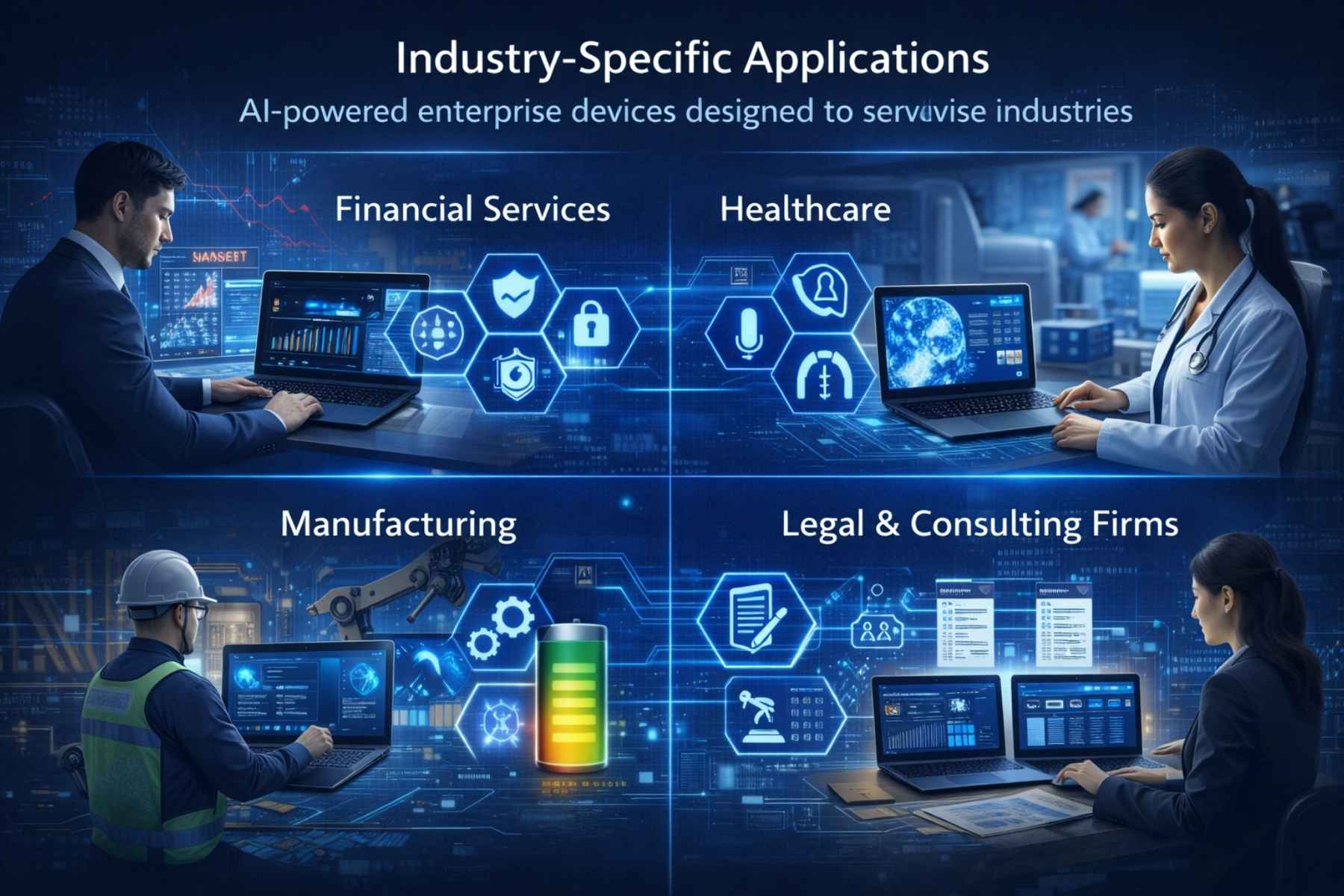
AI-powered enterprise devices must serve diverse industries. Lenovo designed its portfolio with cross-sector adaptability in mind.
1. Financial Services
Financial analysts benefit from:
- Real-time risk modeling acceleration
- AI-assisted fraud detection
- Secure encrypted workflows
2. Healthcare
Medical professionals can utilize:
- Secure patient data processing
- AI-assisted imaging analysis
- Voice-to-record documentation
3. Manufacturing
Factory managers can leverage:
- Predictive maintenance analytics
- AI-powered supply chain monitoring
- Real-time production tracking
4. Legal & Consulting Firms
Professionals gain:
- Instant contract summarization
- Secure document comparison
- Intelligent research assistance
In each scenario, Lenovo AI Business Devices function as AI-enabled productivity multipliers rather than simple computing tools.
Competitive Landscape: How Lenovo Stands Out
The enterprise hardware market includes major global competitors. However, Lenovo’s approach emphasizes:
- Integrated AI acceleration at scale
- Enterprise-ready security from firmware upward
- Sustainability-driven engineering
- Flexible configurations for small to large organizations
While other brands are introducing AI-enabled laptops, Lenovo’s portfolio appears broader and more strategically unified.
The focus is not just on AI features but on building an AI-native enterprise ecosystem.
Scalability for Large Organizations
One critical factor for IT decision-makers is scalability. Can devices be deployed across multiple departments and geographies without compatibility issues?
Lenovo’s centralized device management systems allow:
- Remote updates
- AI feature activation control
- Security patch automation
- Fleet-wide analytics monitoring
This reduces administrative burden and enhances control over large enterprise deployments.
The Human Productivity Factor
Technology adoption succeeds when employees feel empowered — not overwhelmed. The AI integrations in Lenovo AI Business Devices are designed to be subtle and assistive rather than intrusive.
Users are not forced to change workflows dramatically. Instead, AI augments their current habits.
For example:
- Automatic draft suggestions in documents
- AI-generated follow-up reminders
- Context-aware file search
By embedding intelligence naturally into workflows, Lenovo improves productivity without increasing complexity.
What This Means for Global Businesses
Enterprises worldwide are under pressure to digitize operations while managing costs and risks. The introduction of AI-integrated hardware offers a balanced solution:
- Enhanced data privacy
- Faster task completion
- Lower cloud processing dependency
- Reduced cybersecurity exposure
If adoption scales globally, Lenovo AI Business Devices could redefine corporate hardware procurement strategies over the next decade.
Product Portfolio Breakdown
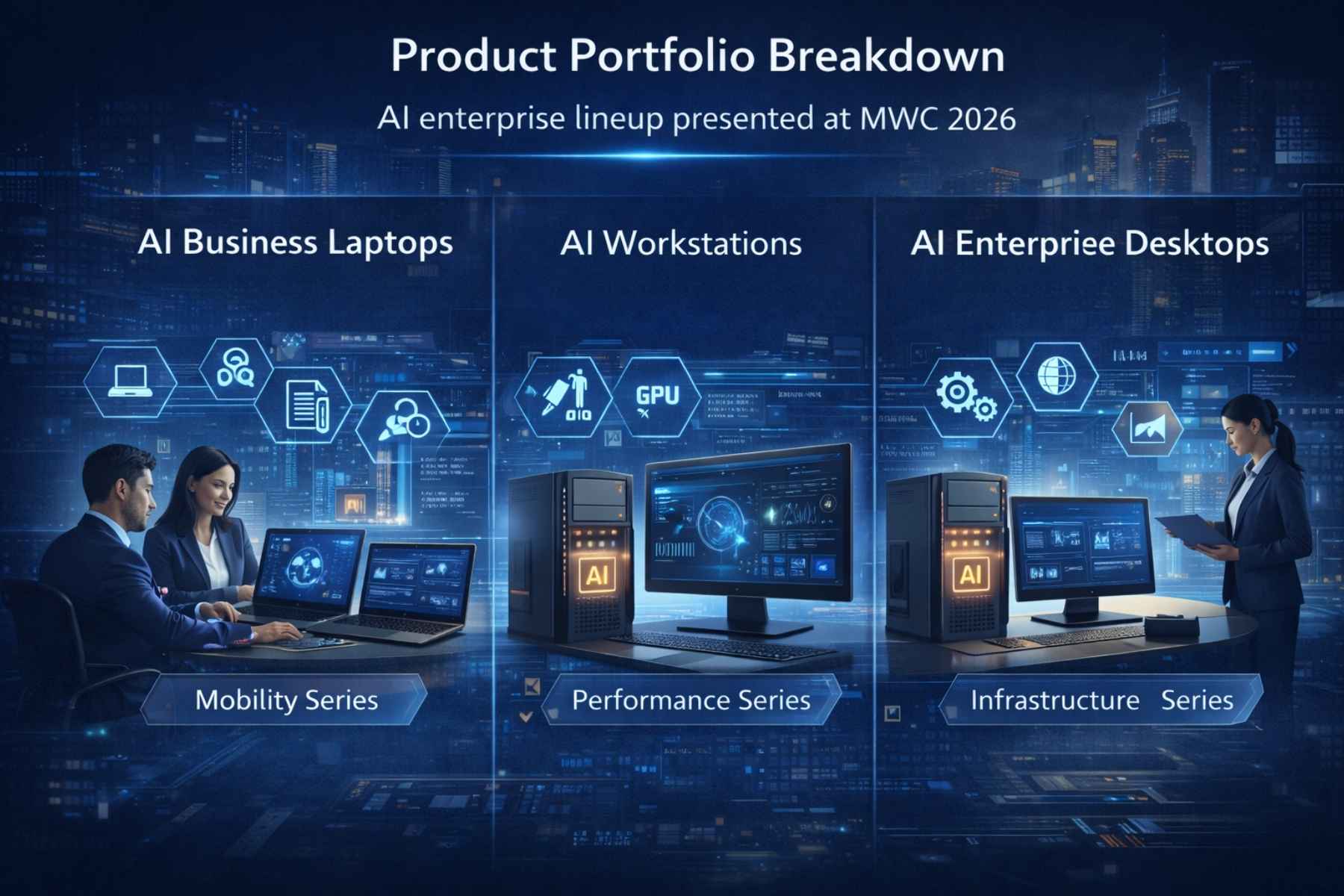
At MWC 2026, Lenovo presented a structured AI enterprise lineup designed to serve small businesses, mid-sized companies, and global corporations alike.
The portfolio can be categorized into three major segments:
1. AI Business Laptops (Mobility Series)
Designed for executives, hybrid workers, consultants, and enterprise professionals, these devices prioritize mobility without compromising AI performance.
Core Features:
- Integrated Neural Processing Units
- Enterprise-grade biometric authentication
- AI-powered meeting enhancement tools
- Intelligent battery optimization
- Advanced thermal regulation
These laptops are ideal for professionals who rely heavily on collaboration tools, cloud dashboards, analytics platforms, and secure communication systems.
Ideal For:
- C-suite executives
- Remote sales teams
- Business consultants
- Financial advisors
The AI optimization ensures smoother video conferencing, faster report generation, and improved multitasking performance.
2. AI Workstations (Performance Series)
This category targets data-intensive industries requiring high computational strength.
Core Capabilities:
- Dedicated AI acceleration cores
- Advanced GPU integration
- Real-time AI model training support
- Enhanced cooling systems
- Large memory scalability
Industries such as engineering, media production, AI research, and fintech stand to benefit significantly from these systems.
Use Case Example:
A financial institution running predictive market analysis models can process simulations faster without excessive cloud dependence. This reduces latency and improves data confidentiality.
3. AI Enterprise Desktops (Infrastructure Series)
For corporate offices deploying large-scale infrastructure, Lenovo introduced AI-enhanced desktop solutions built for reliability and centralized management.
Key Enterprise Benefits:
- Predictive hardware diagnostics
- Fleet-level AI management
- Secure remote administration
- Smart power consumption tracking
Organizations with 500+ employees can use these devices to standardize intelligent computing across departments.
Pricing Strategy & Market Positioning
While final retail pricing varies by configuration and region, Lenovo’s positioning suggests a competitive enterprise pricing strategy.
The company appears focused on:
- Tiered pricing models
- Volume-based enterprise discounts
- AI subscription add-on services
- Long-term IT support packages
Rather than positioning these devices as luxury AI hardware, Lenovo is framing them as practical business investments.
This is critical for adoption in emerging markets as well as established economies.
Deployment Models for Enterprises
Rolling out AI-integrated hardware requires planning. Lenovo supports multiple deployment frameworks.
1. Gradual Migration Model
Organizations replace legacy devices department by department. This approach minimizes disruption and spreads capital expenditure over time.
2. AI-Centric Transformation Model
Companies undergoing digital transformation may adopt Lenovo AI Business Devices at scale to align hardware with AI software investments.
3. Hybrid IT Environment
For enterprises using both on-premise and cloud systems, Lenovo’s AI devices act as intelligent edge nodes, balancing processing between cloud and local resources.
Calculating ROI: Is It Worth the Investment?
For CFOs and CIOs, return on investment is the deciding factor.
Let us break down measurable ROI areas:
1. Productivity Gains
AI-assisted meeting summaries, automated scheduling, predictive system optimization, and contextual search reduce manual workload.
Even saving 30 minutes per employee per day can result in thousands of productive hours annually in large organizations.
2. Reduced Cloud Processing Costs
On-device AI handling decreases reliance on cloud-based inference services. Over time, this lowers recurring subscription and bandwidth costs.
3. Lower Security Incident Costs
AI-driven threat detection helps prevent breaches. Considering the average global cost of a corporate data breach, even one prevented incident may justify hardware upgrades.
4. Energy Efficiency Savings
AI power management reduces electricity consumption across large device fleets, contributing to cost reduction and ESG compliance.
Enterprise Scalability & IT Integration
Large organizations demand seamless compatibility with existing systems.
Lenovo AI Business Devices support:
- Enterprise device management platforms
- Secure authentication protocols
- Integration with productivity suites
- Customizable firmware-level controls
This ensures businesses do not need to rebuild their digital ecosystem to adopt AI-ready hardware.
Long-Term AI Roadmap
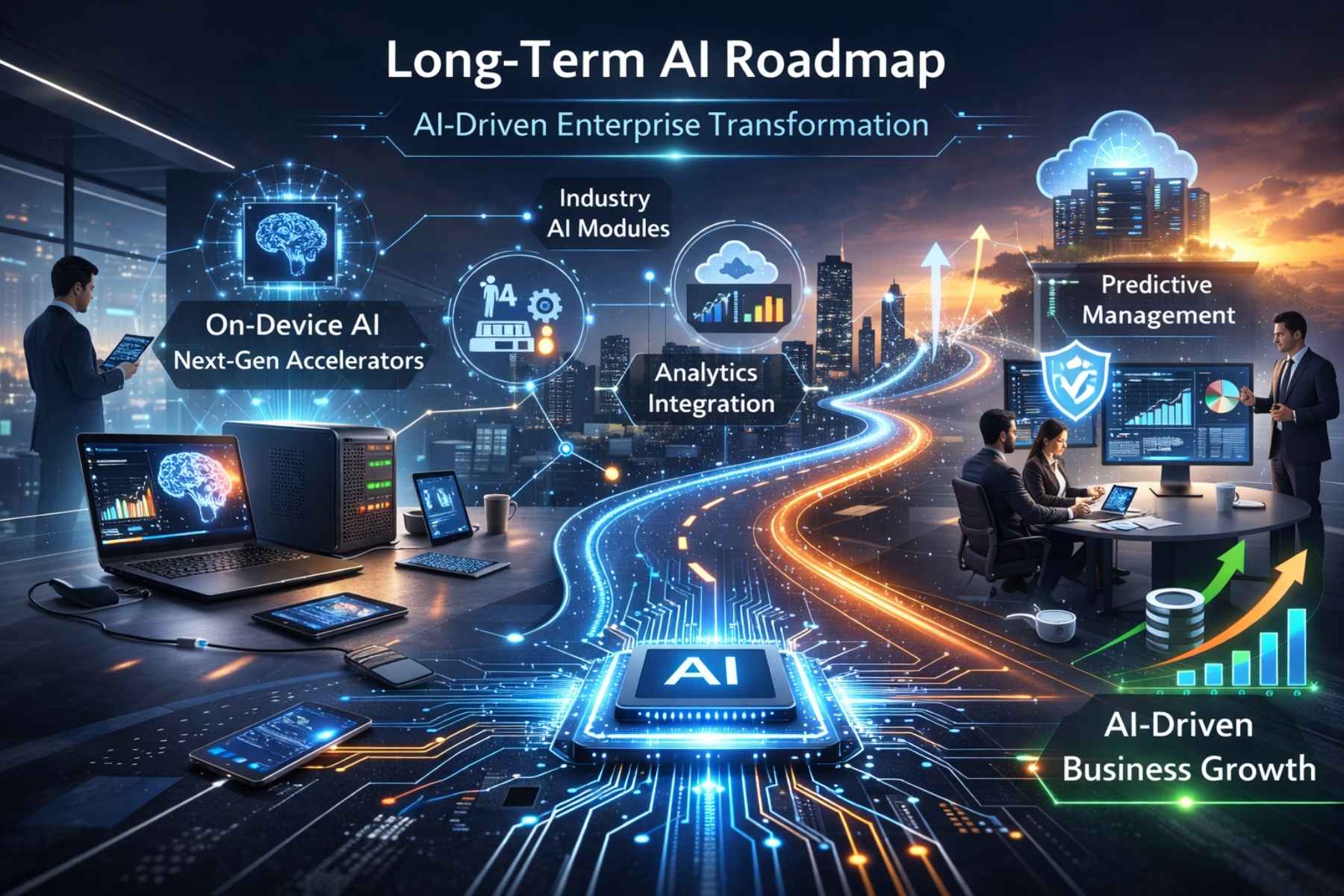
Lenovo’s MWC 2026 announcement is not an isolated launch. It signals a long-term roadmap centered around AI-native enterprise infrastructure.
Future expectations may include:
- More powerful on-device AI accelerators
- Industry-specific AI firmware modules
- Deeper integration with enterprise analytics platforms
- AI-based predictive hardware lifecycle management
By establishing this foundation early, Lenovo positions itself strategically for the next decade of AI-driven business transformation.
Global Market Implications
The enterprise hardware market is entering a new phase. Businesses no longer compare devices solely on processor speed or RAM capacity.
The key evaluation criteria now include:
- AI readiness
- Security intelligence
- Sustainability alignment
- Workflow automation capability
With the introduction of Lenovo AI Business Devices, Lenovo has effectively shifted the conversation from performance benchmarks to intelligent computing ecosystems.
Expert Outlook
Industry analysts predict that AI-integrated enterprise devices will become standard within five years. Companies delaying upgrades may risk productivity gaps compared to competitors adopting AI-native infrastructure.
The MWC 2026 announcement reinforces Lenovo’s ambition to lead that transition.
Competitive Landscape: Where Lenovo Stands
The enterprise computing market includes strong global players such as HP, Dell Technologies, and Apple. Each brand is integrating AI features into business devices, but their strategies differ.
1. Lenovo’s Approach: AI at the Core
Lenovo’s strategy focuses on embedding dedicated AI acceleration hardware directly into enterprise systems. Rather than treating AI as an added software layer, the company integrates intelligence at the firmware and chipset level.
This offers:
- Lower latency
- Reduced dependency on cloud inference
- Improved enterprise data privacy
- Smarter power optimization
2. HP’s Enterprise Focus
HP has emphasized collaboration tools and security enhancements in its AI-ready laptops. However, much of its AI processing remains dependent on cloud integration.
3. Dell’s Infrastructure Strength
Dell Technologies has strong enterprise infrastructure and server integration capabilities. Its AI strategy leans heavily toward data centers and enterprise servers rather than edge computing devices.
4. Apple’s Ecosystem Model
Apple focuses on optimized performance within its ecosystem. While powerful, its enterprise device management flexibility is sometimes limited compared to open corporate environments.
Competitive Advantage Summary
The differentiation of Lenovo AI Business Devices lies in:
- Edge AI processing power
- Enterprise-grade firmware security
- Sustainable energy optimization
- Broad product segmentation
This positions Lenovo uniquely in the AI-native enterprise device category.
Real-World Implementation Scenarios
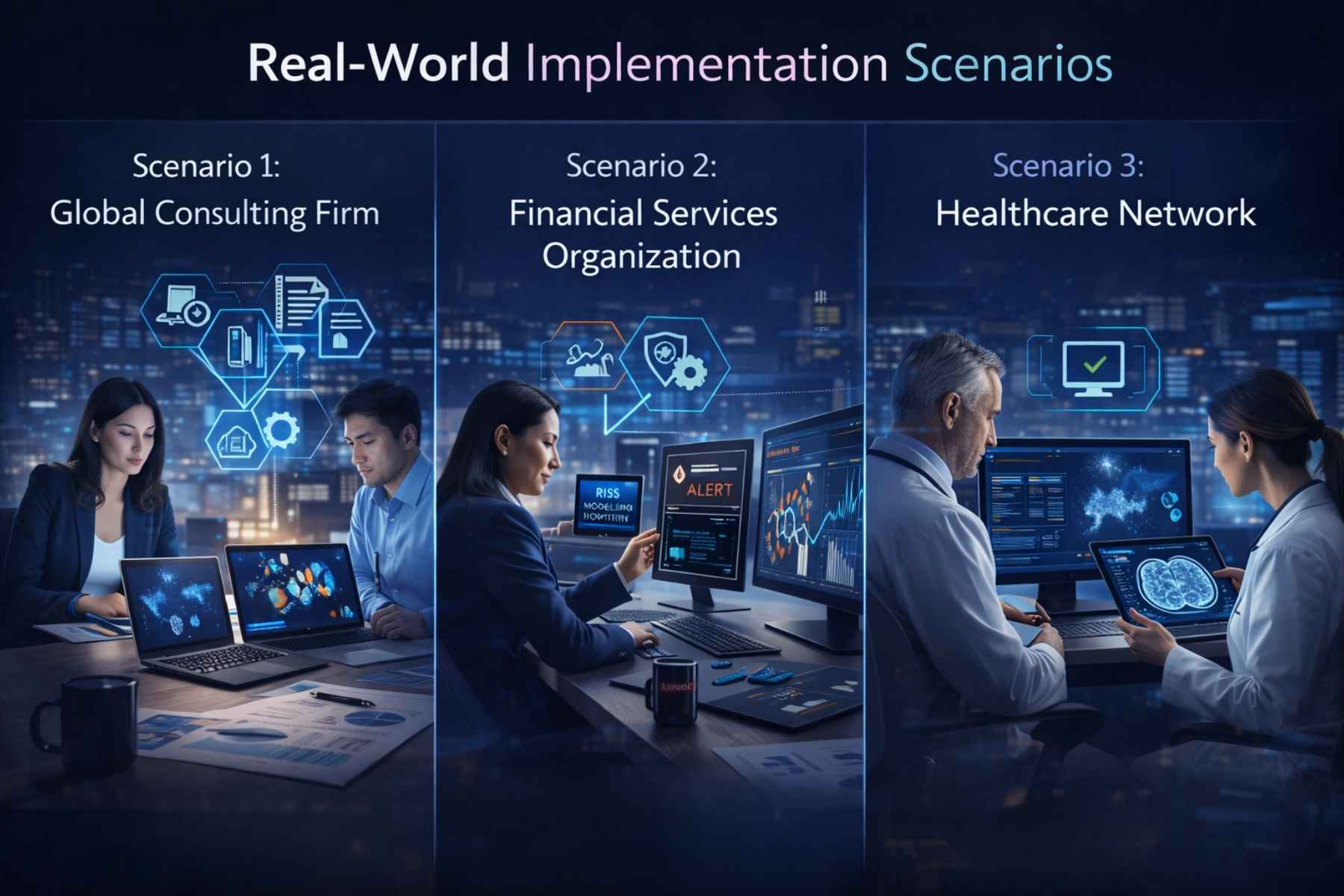
To understand the impact of AI-powered enterprise hardware, let us explore practical deployment examples.
Scenario 1: Global Consulting Firm
A multinational consulting company deploys 5,000 AI-enabled business laptops across offices worldwide.
Impact:
- AI meeting summaries reduce documentation workload
- Real-time translation improves cross-border collaboration
- Predictive performance optimization minimizes downtime
Within one year, productivity metrics improve, and IT maintenance costs decline due to intelligent diagnostics.
Scenario 2: Financial Services Organization
A banking institution integrates AI workstations for risk modeling and fraud detection analysis.
Results:
- Faster algorithm testing
- Reduced cloud processing fees
- Enhanced local data encryption
By using Lenovo AI Business Devices, the bank strengthens compliance while improving computational speed.
Scenario 3: Healthcare Network
Hospitals deploy AI desktops to administrative and diagnostic departments.
Benefits:
- Voice-to-text patient documentation
- AI-assisted imaging reviews
- Secure medical record access
These systems reduce manual administrative time and improve diagnostic efficiency.
Governance, Compliance & Data Privacy
As AI adoption increases, so does regulatory scrutiny. Enterprises must comply with regional and international data protection laws.
Lenovo’s on-device AI processing reduces the amount of sensitive data transmitted to external cloud servers. This improves:
- GDPR compliance in Europe
- Data localization in Asia-Pacific
- Financial data security standards globally
For multinational corporations, compliance-ready hardware significantly lowers legal risk exposure.
Challenges & Considerations
No technological shift is without obstacles. Enterprises considering adoption of Lenovo AI Business Devices should evaluate:
1. Initial Capital Investment
AI-integrated hardware may involve higher upfront costs compared to traditional business laptops. However, long-term operational savings can offset initial expenses.
2. Employee Training
AI features are powerful, but employees must understand how to utilize them effectively. Organizations may need structured onboarding sessions.
3. IT Integration Planning
Legacy systems must be compatible with AI-optimized firmware and management tools. Pre-deployment audits are recommended.
The Strategic Importance of Edge AI
The broader significance of Lenovo’s announcement extends beyond device performance.
Edge AI processing data locally rather than in centralized servers is becoming a strategic priority for enterprises concerned about:
- Data privacy
- Latency reduction
- Bandwidth limitations
- Cost control
By embedding AI capabilities directly into enterprise hardware, Lenovo AI Business Devices align with this global shift toward distributed intelligence.
AI as a Long-Term Infrastructure Investment
Enterprise leaders are increasingly viewing AI not as a software experiment, but as core infrastructure.
Hardware must now support:
- AI model inference
- Predictive analytics
- Intelligent automation
- Secure local computation
Lenovo’s AI-native enterprise lineup indicates a transition toward long-term AI-ready infrastructure planning.
Expert Analysis & Industry Forecast
Technology analysts anticipate that within five years:
- AI acceleration chips will become standard in enterprise laptops
- On-device AI processing will reduce cloud strain
- Hardware vendors will compete primarily on AI efficiency
The introduction of Lenovo AI Business Devices may accelerate this transition, especially among businesses seeking scalable, secure, and sustainable computing frameworks.
Strategic Adoption Recommendations
Lenovo AI Business Devices for organisations considering implementation:
- Conduct AI readiness assessments
- Identify departments with highest AI workload demand
- Pilot devices in controlled environments
- Measure productivity improvements
- Scale deployment strategically
This phased approach ensures optimized ROI and smoother transition.
Long-Term Industry Outlook
The announcement at MWC 2026 signals a turning point in enterprise hardware strategy. Over the next decade, several trends are expected to accelerate:
1. AI as Standard Hardware Component
Just as SSD storage replaced HDD drives, AI acceleration chips are likely to become standard in business devices.
2. Reduced Cloud Overload
On-device AI will decrease pressure on centralized cloud systems, reducing operational costs and improving privacy compliance.
3. Intelligent Device Autonomy
Enterprise devices will increasingly:
- Self-optimize performance
- Predict hardware failures
- Automate updates
- Adapt to user workflows
The introduction of Lenovo AI Business Devices reflects this evolution toward intelligent autonomy.
Global Business Implications
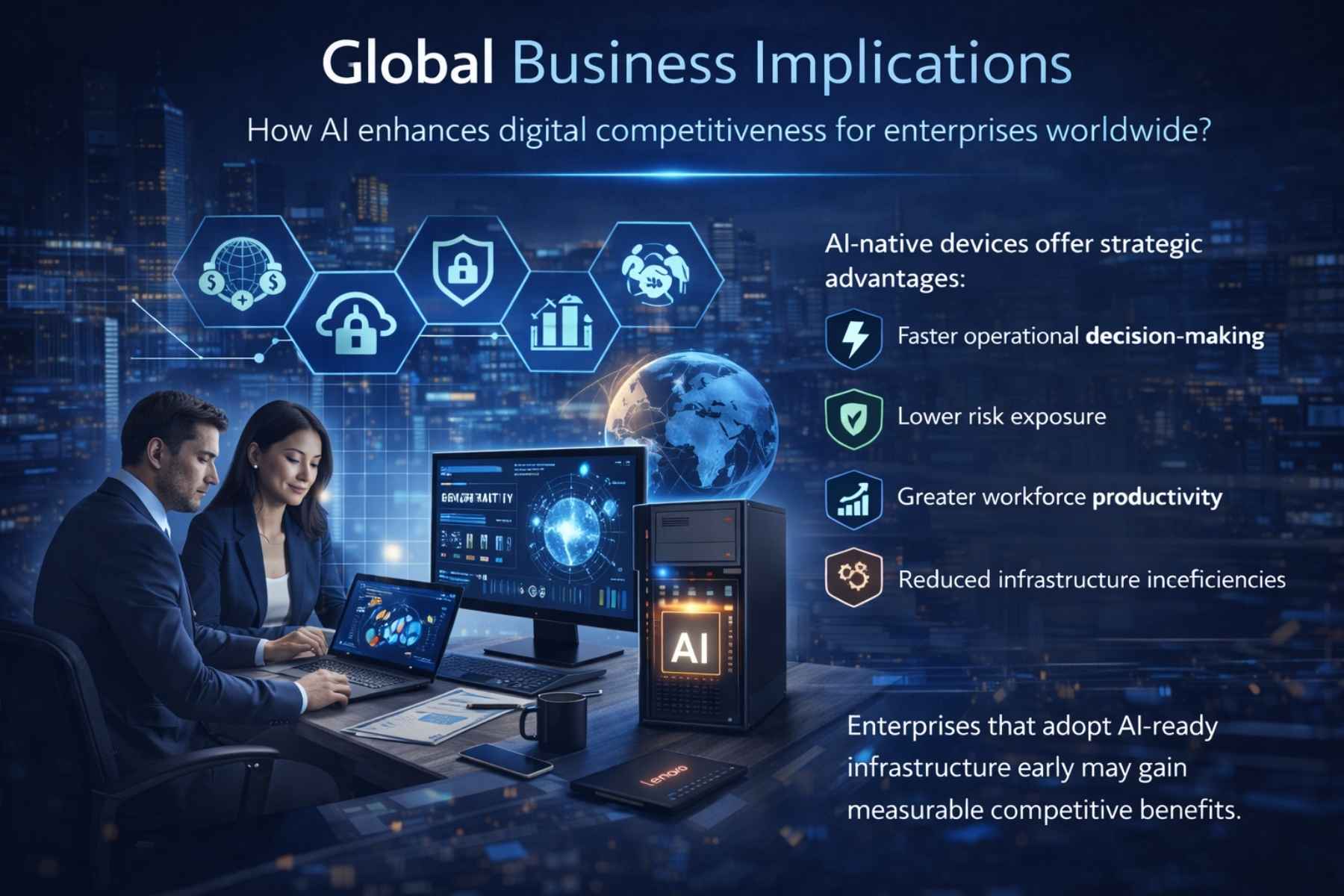
Companies worldwide are navigating economic uncertainty, cybersecurity threats, sustainability requirements, and workforce transformation. Hardware decisions now influence long-term digital competitiveness.
AI-native devices offer strategic advantages:
- Faster operational decision-making
- Lower risk exposure
- Greater workforce productivity
- Reduced infrastructure inefficiencies
Enterprises that adopt AI-ready infrastructure early may gain measurable competitive benefits.
Strategic Summary
The impact of Lenovo AI Business Devices can be understood across five pillars:
1. Performance
Dedicated AI processing ensures smoother, faster execution of AI-driven workflows.
2. Security
Behavioral AI monitoring strengthens enterprise protection.
3. Efficiency
Smart power and workload management reduce operational costs.
4. Scalability
Enterprise-wide deployment options support global expansion.
5. Sustainability
Energy-optimized hardware aligns with ESG objectives.
Frequently Asked Questions
1. What are Lenovo AI Business Devices?
Lenovo AI Business Devices refer to Lenovo’s new generation of enterprise laptops, desktops, and workstations equipped with dedicated AI acceleration hardware such as Neural Processing Units (NPUs). These systems are designed to handle AI workloads directly on-device, improving performance, security, and efficiency.
2. How are these devices different from traditional business laptops?
Traditional business laptops rely primarily on CPU and cloud-based processing for AI tasks. In contrast, Lenovo AI Business Devices integrate dedicated AI hardware that processes tasks locally, resulting in:
- Faster AI response times
- Reduced cloud dependency
- Lower latency
- Improved energy efficiency
- Enhanced data privacy
3. Are Lenovo AI Business Devices suitable for small businesses?
Yes. Lenovo’s tiered portfolio includes models suitable for startups and small enterprises. Smaller organizations can benefit from AI-assisted productivity features, improved security, and energy savings without requiring large-scale infrastructure.
4. Do these devices require constant cloud connectivity?
No. One of the major advantages of Lenovo AI Business Devices is on-device AI processing. While cloud connectivity can enhance certain services, many AI tasks operate independently, reducing bandwidth dependency.
5. How do these devices improve cybersecurity?
The AI security architecture monitors system behavior in real time. It can detect anomalies, block suspicious processes, and protect firmware integrity. This proactive model reduces vulnerability to modern cyber threats.
6. What industries benefit the most?
Industries likely to see strong returns include:
- Financial services
- Healthcare
- Legal and consulting
- Manufacturing
- Engineering and design
- Enterprise IT departments
However, virtually any knowledge-based business can benefit from AI-enhanced productivity tools.
7. Are Lenovo AI Business Devices future-proof?
While no technology is permanently future-proof, these systems are designed with scalable AI architecture. Dedicated NPUs and firmware-level AI integration position them well for upcoming AI software advancements.
Conclusion
The unveiling of Lenovo AI Business Devices at MWC 2026 represents a decisive step toward AI-native enterprise computing. Rather than treating artificial intelligence as an add-on feature, Lenovo has embedded intelligence directly into the foundation of its business hardware ecosystem.
Lenovo AI business devices for organisations evaluating their next technology upgrade cycle, the conversation is no longer limited to processor speed, RAM capacity, or storage expansion. The defining question is whether enterprise hardware is capable of supporting AI-driven workflows securely, efficiently, and sustainably.
Lenovo’s AI-integrated portfolio addresses this shift directly. By combining edge AI processing, enterprise-grade security, scalable deployment models, and sustainability alignment, Lenovo positions itself as a forward-thinking leader in business computing.
As digital transformation accelerates globally, enterprises that prioritize AI-ready infrastructure today may establish stronger operational resilience tomorrow.
The evolution of business computing has entered a new phase: intelligent, adaptive, and AI-powered. And with the introduction of Lenovo AI Business Devices, that future is already taking shape.
Explore More: Google Pixel 10a Release: $499 Price, Specs, Camera & AI Features